This is the inaugural issue compiling the City of Literature columns, a regular feature on Dumaguete MetroPost, which celebrates the vibrant literary culture and heritage of Dumaguete City, in anticipation of its bid to be designated as UNESCO City of Literature under the Creative Cities Network. This column is produced by the Buglas Writers Guild, a network of literary artists from Negros Oriental, Negros Occidental, and Siquijor. Each week, we will focus on the work of one local writer. For this month, the guest editor of City of Literature is Dumaguete fictionist Ian Rosales Casocot.
* * *
Each one of us has a crazy dream. To climb Mount Everest, for example, or to write a complicated symphony. Or to bake the world’s largest pizza, if that’s more your thing. In my quiet moments, when I ponder about the things I have written—or plan to write—I think about how wonderful it would be to write a good YA novel, in the vein of The Perks of Being a Wallflower or The Fault in Our Stars, but with a Filipino context and sensibility, something I have yet to really see from a Philippine author.
I have been writing for most of my life, and so it is not exactly out of left field for me to dream of big things that are literary. What is a little bit audacious, however, is an even bigger dream: to make Dumaguete a UNESCO City of Literature. This is part of UNESCO’s Creative Cities Network, which it launched in 2004, to answer what it perceived to be a need to foster appreciation for cultural diversity around the world. The aim is to “promote the social, economic and cultural development of cities in both the developed and the developing world,” through literature, music, film, media, gastronomy, crafts and folk art, and design.
To be approved as a City of Literature, cities must satisfy a number of criteria that mark its affinity to the written word, where literature must be seen to play an important role in city life: this includes the quality, quantity, and diversity of publishing in the city; the quality and quantity of educational programs focusing on domestic or foreign literature in schools at all levels; the hosting literary events and festivals which promote domestic and foreign literature; the existence of libraries, bookstores, and public or private cultural centers which preserve, promote, and disseminate domestic and foreign literature; the involvement by the publishing sector in translating literary works from diverse national languages and foreign literature; and an active involvement of traditional and new media in promoting literature and strengthening the market for literary products. A tall order—but the benefits of being accorded the honor are huge.
To date, there are only 53 Cities of Literature all over the world, which include Edinburgh, Scotland (2004), Melbourne, Australia (2008), Dublin, Ireland (2010), Reykjavík, Iceland (2011), Norwich, England (2012), and Kraków, Poland (2013).
In November 2008, Iowa City in Iowa, U.S.A. became the third city in the world to be declared by the UNESCO as an official City of Literature. Its Creative Cities Network program cites that “[s]ince 1955, graduates and faculty of the University of Iowa have won more than 25 Pulitzer Prizes in literature. Iowa City has been home to such acclaimed authors as Flannery O’Connor, Wallace Stegner, and Kurt Vonnegut Jr. And the world-famous Iowa Writers’ Workshop was the world’s first Master of Fine Arts degree program in creative writing…”
I am specific about my mention of Iowa City as a City of Literature, because halfway around the world, in the heart of the Visayas, Dumaguete is very much Iowa City’s literary twin. Its inclusion in the ranks of these literary cities could prove to be a portal with which we can lay claim to the same distinction.
The writer Rowena Tiempo-Torrevillas, a native of Dumaguete and a current resident of Iowa City once called the latter her “blonde Dumaguete.” Indeed, both share between them a wealth of literary developments that have lasted more than sixty years. “In 1946,” she once wrote, “my father [Edilberto K. Tiempo] was offered a scholarship by the Presbyterian Board of Missions, enabling him to do graduate work in the United States, at Stanford. He was readying himself for the scholarly regimen of the classics, and doing a refresher course in Latin, among his preparations, when my father was asked what area he wanted to specialize in at Stanford. ‘Creative writing,’ he said. ‘There are a number of novels I am going to write, and I need to know if I’m writing them effectively and well.’
“’Oh,’ the Presbyterian Board officer told him, ‘then there’s only one place for you to go. Iowa.’ Dad had to look up Iowa in the encyclopedia, and he was a bit puzzled at what he read. ‘Isn’t that where…they grow corn?’”
Iowa, right smack in the cornfields and silos of the American Midwest, indeed grew corn. But Dr. E.K. Tiempo was soon to learn there was a man there. It was a poet named Paul Engle, and he ran what was and still is considered the best creative writing workshop in the world: the Iowa Writers’ Workshop at the University of Iowa. “And that is how my Dad,” Rowena Torrevillas continued, “took a freighter across the Pacific, then a train halfway across the continent from San Francisco to Iowa City. And one morning, carrying his belongings in an Army-issue duffel bag, he crossed the Pentacrest on the campus to find the postwar temporary quarters in the Nissen huts, the quonset building where Paul Engle was holding the Writers’ Workshop.”
By 1947, Dr. E.K. Tiempo’s wife, Edith Lopez Tiempo, also joined to take part in the writing program in Iowa. When the Tiempos returned to the Philippines in 1951, Silliman University was already abuzz with creative writing. The campus was sprouting literary enthusiasts, among them Aida Rivera-Ford, Rodrigo and Dolores Feria, and Ricaredo Demetillo. The Tiempos made creative writing an area of concentration for English majors in the English Department—and soon that paved the way to preparations in 1961 to hold a workshop similar to the one they attended in Iowa. The following year, it became fully operational, and now it is known as the Silliman University National Writers Workshop.
In 1962, Engle himself visited Dumaguete, and met at the Silliman workshop two Asian writers, Ko Won and Wilfrido Nolledo. These two writers would soon form the nucleus of what was to be the Internatinal Writing Program, which Engle founded in 1967 with his wife, the Chinese writer Hualing Nieh Engle. Rowena Torrevillas, upon returning to Iowa City in the 1980s, would become part of the IWP staff, becoming its coordinator for many years, and editing with Paul Engle the 20th anniversary anthology of the IWP titled “The World Comes to Iowa.” By 2011, nineteen alumni and panelists of the Silliman University National Writers Workshop, would go to Iowa as fellows of the IWP, including Wilfrido Nolledo in 1967, Cirilo Bautista in 1968, Erwin Castillo in 1969, Ninotchka Rosca in 1977, Alfred Yuson in 1978, Rowena Tiempo Torrevillas in 1984, Edgardo Maranan in 1985, Fidelito Cortes in 1986, Marra PL. Lanot in 1986, Susan S. Lara in 1987, Rofel Brion in 1990, Ophelia Alcantara Dimalanta in 1990, Gemino H. Abad in 1991, Marjorie Evasco in 2002, Charlson Ong in 2002, Sarge Lacuesta in 2007, Vicente Garcia Groyon in 2009, yours truly in 2010, and Joel Toledo in 2011.
In 2005, writing fellows from the Nonfiction Writing Program at The University of Iowa, under Robin Hemley, also took part in the National Writers Workshop in Dumaguete, with Angela Balcita, Elizabeth Rae Cowan, Matthew Davis, Bernadette Esposito, Brian Goedde, Jynelle Gracia, Bonnie Rough, and Alex Sheshunoff. The program also sent visiting writers from Iowa to Dumaguete during the workshop’s 50th anniversary in 2011.
It has been a rich literary relationship between two cities. But does Dumaguete have what it takes to be City of Literature? Do we have diversity of publishing in the city? Not exactly, but that can be done, if only we can get visionaries to see the value of a city that publishes books. Do our educational programs focusing on domestic or foreign literature in schools at all levels? They do, but perhaps a sharper focus—with attendant assistance by those in the know—is in order. Do we host literary events and festivals which promote domestic and foreign literature? By God, yes, and plenty of that. Do we have libraries, bookstores, and public or private cultural centers which preserve, promote, and disseminate domestic and foreign literature? Our public library needs help, we can do more than just have National Bookstore in our midst, but we do have cultural centers that do a fine job of literary dissemination. Does the local publishing sector help in translating literary works from diverse national languages and foreign literature? None of that, as yet. Is there an active involvement of traditional and new media in promoting literature and strengthening the market for literary products? It can be done—but we need to do the work.
The Philippine UNESCO Commission has just endorsed Dumaguete as its aspiring City of Literature for 2025. We can do this. It will be an audacious undertaking necessitating a complete overhaul of how we think of this beloved city. But it can be done.
This is a pop-up issue of Buglas Writers Journal celebrating the 123rd Founders Day of Silliman University in Dumaguete City. It cannot be argued that if Dumaguete is a City of Literature, one of the biggest reasons for this distinction is the presence of Silliman University, which, since its founding in 1901 by Presbyterian missionaries, has somehow come to hone the literary talents of many of the the country’s best writers. Part of the story, of course, is the founding of the Silliman University National Writers Workshop in 1962 by Edilberto and Edith Tiempo — but beyond the workshop, the university itself as cradle of literary writing is something that begs examination and is truly something to celebrate. That history has its ups and downs, but the the importance of that literary legacy cannot be denied.
In 2001, in celebration of the school centennial, Sands & Coral, the literary folio of Silliman University — which was founded by Rodrigo T. Feria in 1948, with Aida Rivera Ford and Cesar Jalandoni Amigo as its first editors — came out with a unique generational anthology that celebrated the literary writing in campus since the 1940s, the decade the folio was born. The issue contained the usual stories and poems, but what made it groundbreaking were the generational memoirs written by specific writers from every decade of Silliman writing, from the 1940s to the 1990s. Each piece has the writer recalling mostly their work for the Sands & Coral, but also gives us a glimpse of what the culture of literary writing was like in their decade — hence, a treasure trove of generational writing memories.
This issue reprints those essays, from Aida Rivera Ford in the 1940s to Graciano H. Arinday Jr. in the 1950s, from Myrna Pena-Reyes and Cesar Ruiz Aquino in the 1960s to Anthony L. Tan in the 1970s, from Timothy R. Montes in the 1980s to Anne-Marie Jennifer Eligio and Shielfa Alojamiento in the 1990s — each recounting the pain and the joy, the disappointments and the exhilaration, and the very Sillimanian travails unique to a Dumaguete writer.
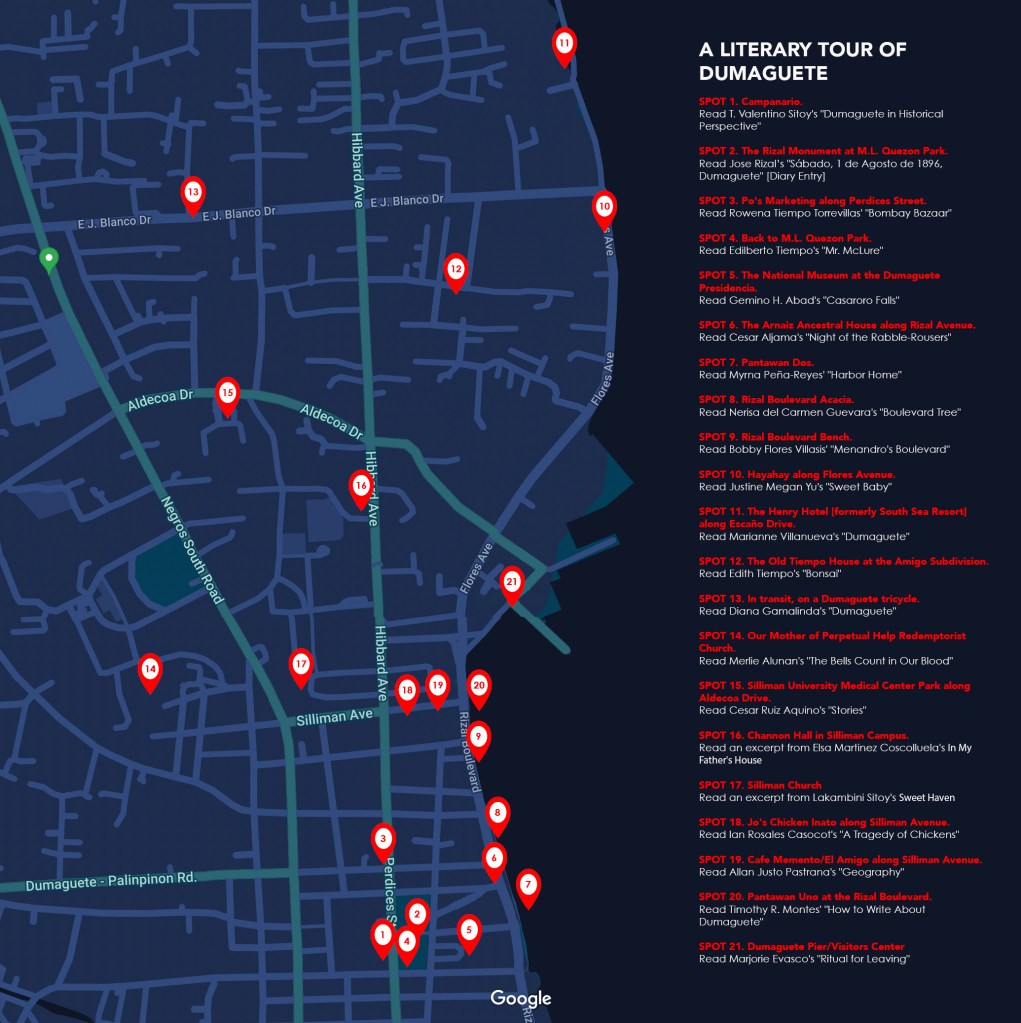
This April, we celebrate National Literature Month, and this May, we celebrate National Heritage Month. So what better way to celebrate these two national cultural fests than by mapping out a virtual “litera-tour” of Dumaguete, highlighting the works of key authors in Negros Oriental and at the same time celebrating their works as important intangible heritage of the community! It’s a unique DIY tour you can take to get to know Dumaguete in an approximation of its literary splendor.
We encourage you to take this issue of Buglas Writers Journal as a map to do your own walking tour of specific sites in Dumaguete that have valuable connections with various pieces of literary works, giving the reader/tourist a chance to appreciate the works and to see the significance of specific places in Dumaguete in the light of the literary. [This issue will be closely connected to our Facebook postings.]
In a way, we are aiming to underline the importance of Dumaguete as a “City of Literature” in the Philippines, where many Filipino writers—both local and national [and international]—have aspired to set many of their stories, poems, dramas, and creative non-fiction: Dumaguete as inspirational wonderland.
We have chosen twenty-one spots in Dumaguete that can be found in passages of relevant literary texts. Let’s begin…
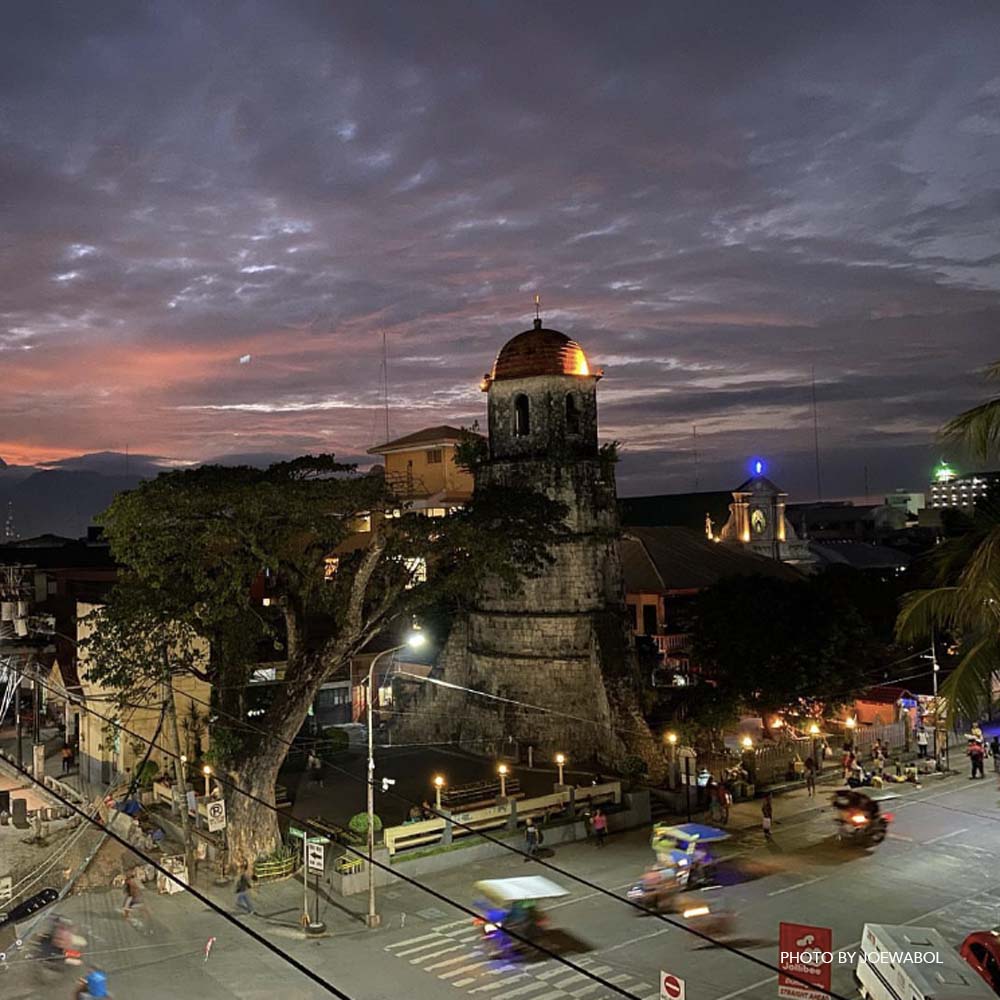
We will begin this literary tour at the Campanario de Dumaguete, or the Dumaguete Belltower, long the symbol of the city. The campanario was built during the time of Fray Juan Felix de la Encarnacion who took charge of the Dumaguete parish between 1867 and 1879. It is set on the remains of the original southeastern watchtower originally built by Fray Jose Manuel Fernandez de Septien, parish priest of Dumaguete, between 1755 and 1760. Fr. Septien could very well be considered as the “Father of Dumaguete,” because it was through his efforts that the town grew in strength, even managing to deflect marauding pirates from the South. This literary tour begins with a comprehensive look at the history of Dumaguete, written by one of its eminent historians, Dr. T. Valentino Sitoy Jr.
SPOT 2: THE JOSE RIZAL MONUMENT AT THE M.L. QUEZON PARK
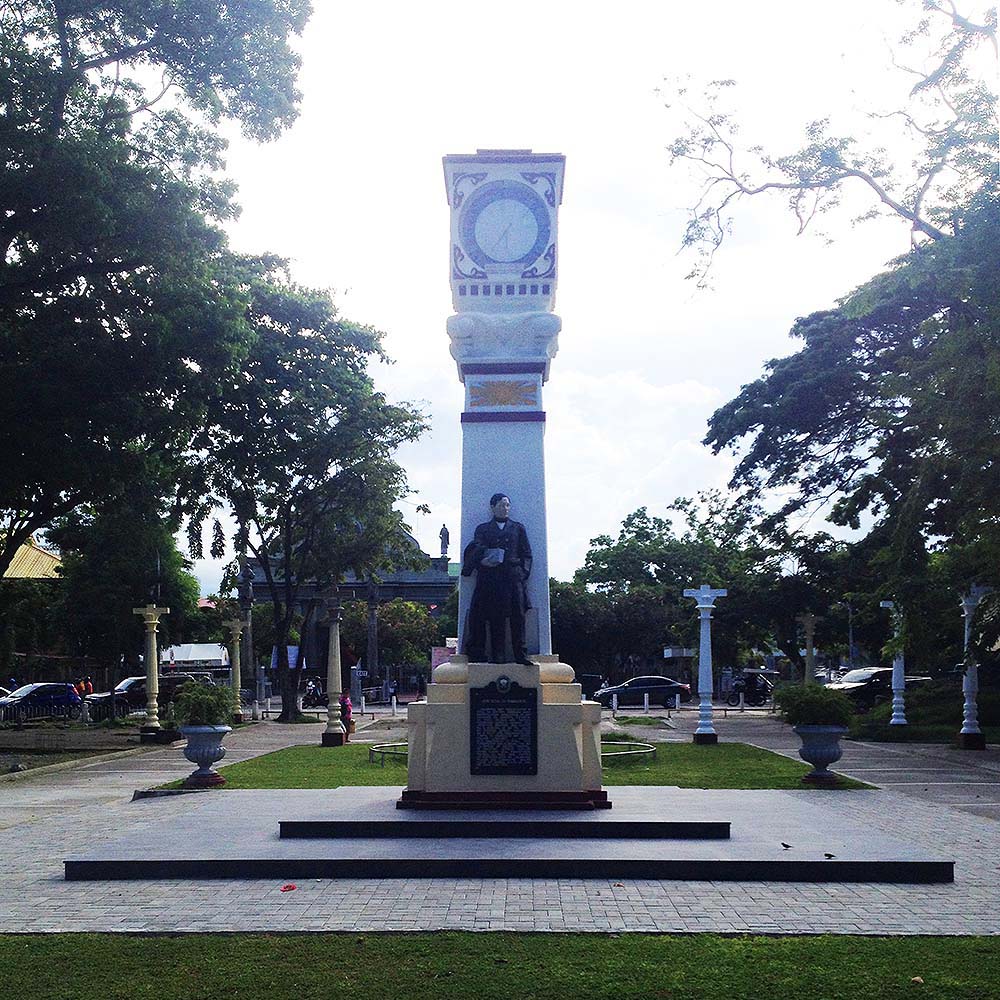
From the campanario, proceed to the monument of Jose Rizal in M.L. Quezon Park. Cross Perdices Street, and enter the city plaza from the western side and proceed to the center, where the statue of the National Hero is located. Rizal came to Dumaguete twice: in 1892, right before he arrived in Dapitan for the start of his exile, where it was noted that he had breakfast at the house of one Jose Longa; and then in 1896, right after he departed Dapitan at the end of his exile, on the way to Manila to volunteer his services as doctor in the Spanish enclave of Cuba—an aborted plan since he was immediately arrested by Spanish authorities, and by the end of the year was executed at Bagumbayan.
SPOT 3: PO’S MARKETING AT THE CORNER OF LOCSIN STREET AND PERDICES STREET
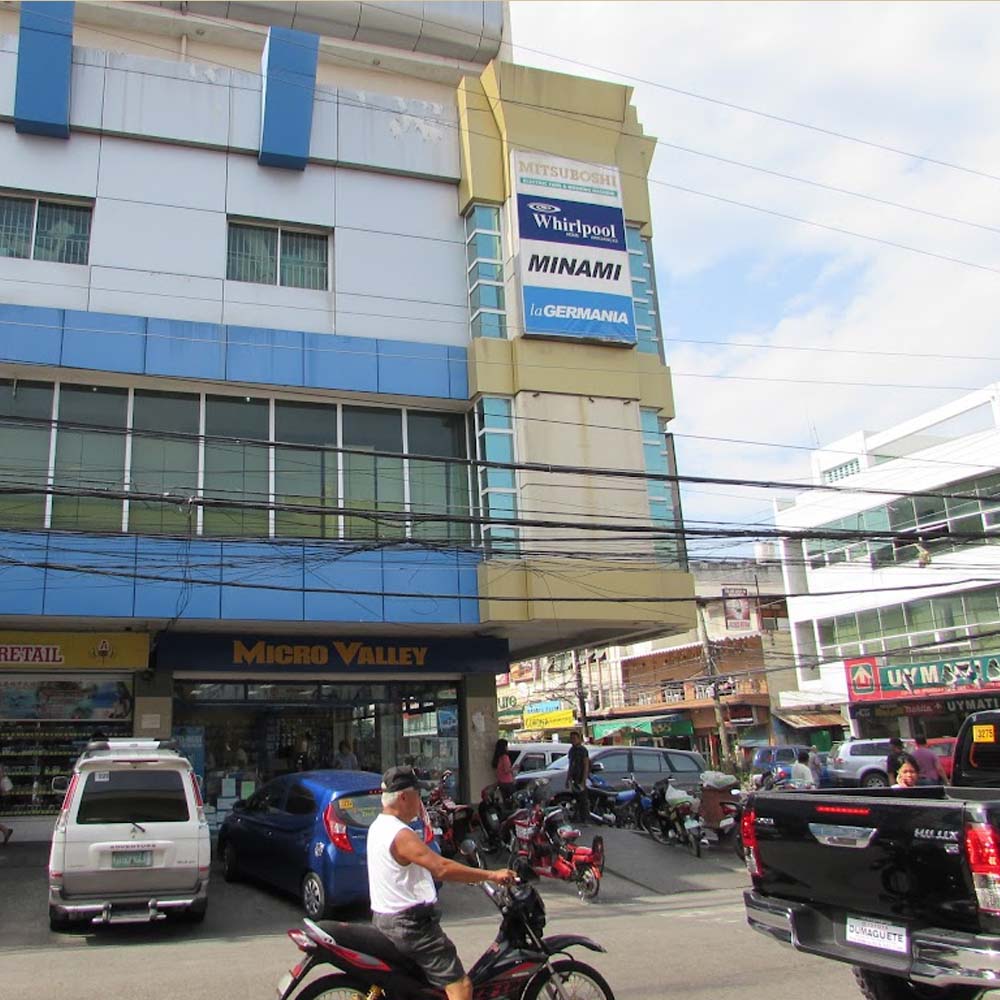
From the statue of Jose Rizal in M.L. Quezon Park, exit the plaza in the western side, facing the Catholic Church, and proceed on foot turning right on Perdices Street [formerly Calle Alfonso XIII]. Go northwards, crossing one block, until you get to the corner of Perdices Street and Locsin Street. On the northwest corner stands Po’s Marketing, which was constructed from the ruins of Hassaram’s Department Store, which burned down in 2007. Hassaram’s and Rajan’s Department Store were two of the earliest department stores in Dumaguete, owned by South Asian immigrants. Also in this area was located Bombay’s Bazar. Reading Torrevillas’ essay, how did Dumaguete locals treat langyaw [or strangers] in their midst?
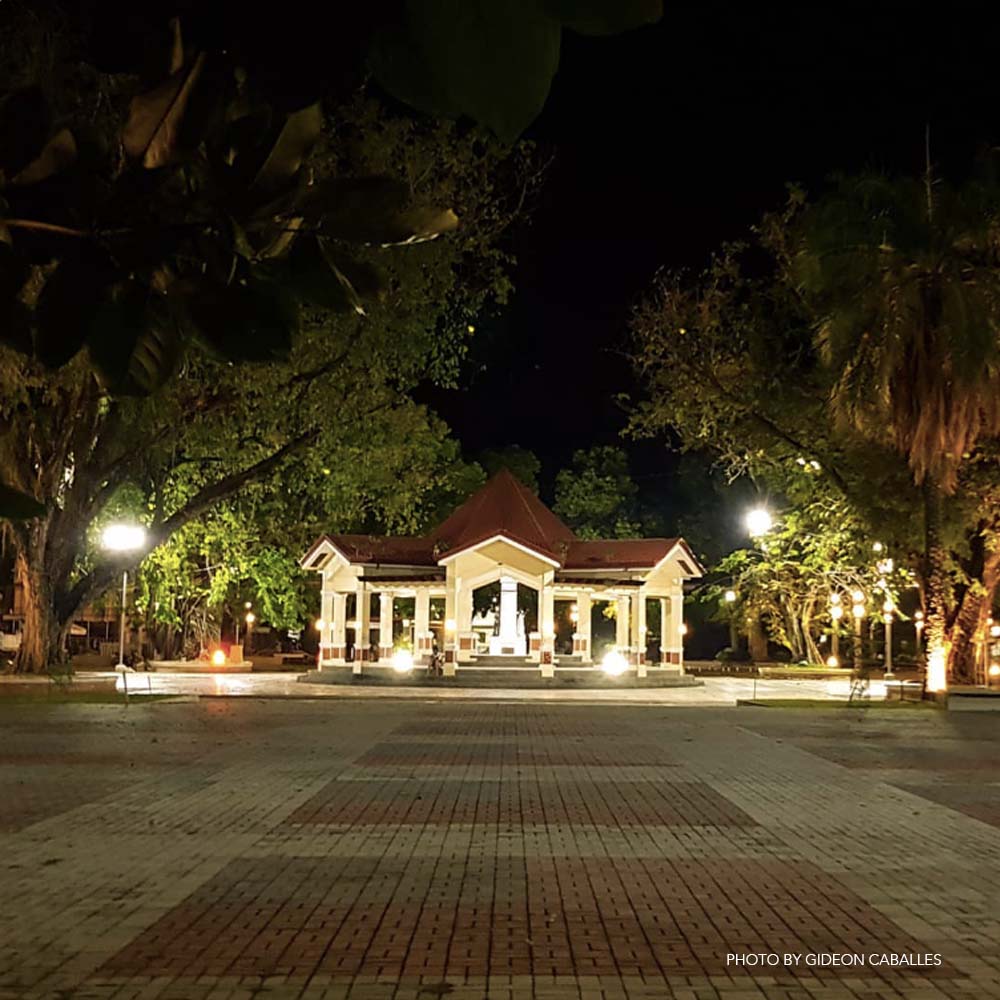
Go back to M.L. Quezon Park, and contemplate it and its environs. Quezon Park in Dumaguete is not only the veritable center of the city, it is also the true mark of confluence in terms of Oriental Negrense history. The plaza occupies the space between the Cathedral of St. Catherine of Alexandria [the original foundation of which was built in 1754] and the Presidencia [built in 1937 by renowned Filipino architect Juan Arellano], and by its very location has been witness to the historical upheavals and progress of Dumaguete at the height of both Spanish and American colonial rules. It was in this space, for example, that Don Diego de la Viña and his men settled when they arrived in Dumaguete from Guihulngan on 24 November 1898, completing the liberation of Negros Oriental from Spanish rule. Formerly a field of weeds, and then a corn field, and finally a makeshift plaza between the casa tribunal and the Catholic Church, Quezon Park was formally dedicated in the afternoon of 17 September 1916 with the firing of cannons, speeches, music, and refreshments—marking a year of rapid progress in Dumaguete. Quezon Park was refurbished under the direction of Sr. Juan Posadas, transforming the area into recreation grounds with green lawns, gravel walks, flower beds, and concrete benches. It was named after the statesman Manuel L. Quezon, even before he became the President of the Philippine Commonwealth in 1935. This was in honor of his efforts in the passage of the Jones Law, or the Philippine Autonomy Act, in 29 August 1916. Quezon had been one of the Philippines’ two resident commissioners to the U.S. House of Representatives, and had drafted at least two versions of the Jones Bill. Quezon would make frequent visits to Dumaguete in the ensuing years, developing a close relationship with the place. After World War II broke out in the Pacific and the Japanese Occupation began, Quezon and members of his family, and their military escorts, slipped off to safety in Australia from the port in Dumaguete by submarine on 6 March 1942. In Tiempo’s story, we meet an American resident of Dumaguete, who lives in a house with a great view of the park and its environs, and whose life somehow mirrors much of the historical upheavals of the town.
SPOT 5: THE NATIONAL MUSEUM AT THE DUMAGUETE PRESIDENCIA
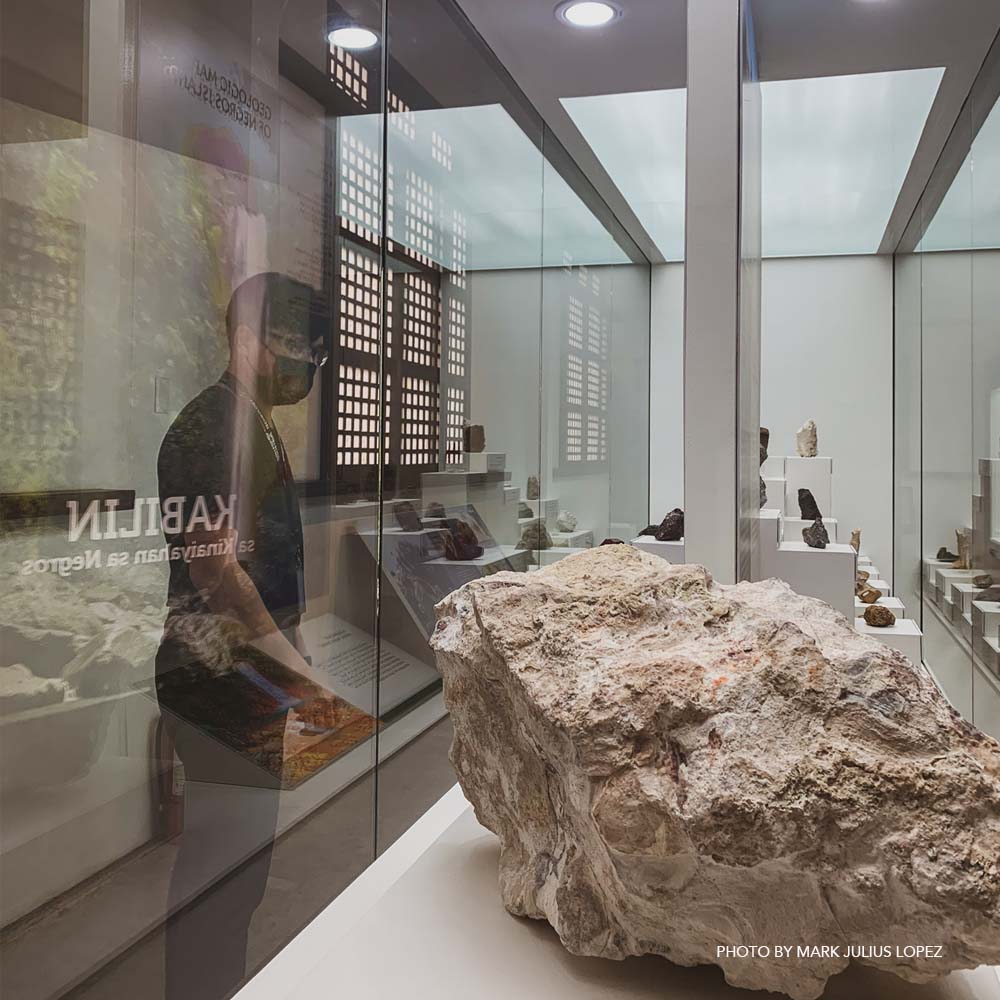
Proceed to the Presidencia, which currently houses the National Museum of Dumaguete. In 2017, the City of Dumaguete turned over the restoration of the original architecture, built in 1937 and designed by the great Filipino architect Juan Arellano, to the National Museum of the Philippines, which now oversees a Dumaguete branch in the property. Opened in November 2022, the National Museum of Dumaguete currently showcases sections on local natural history, on local anthropology and archaelogy, and on heritage edifices found in Negros Oriental and Siquijor. Part of the natural history display are various flora and fauna found in the island of Negros, as well as minerals and rocks sampled from various sites, including Mt. Talinis and Casaroro Falls. Because we are confining ourselves in this literary tour within the borders of Dumaguete, we can try to explore within the National Museum other places outside of the city, such as Casaroro Falls in Valencia, that have inspired Filipino writers, like this poem by National Artist for Literature Gemino H. Abad.
SPOT 6: THE ARNAIZ ANCESTRAL HOUSE ALONG RIZAL AVENUE
From the National Museum, exit through the Calle Sta. Catalina gate and turn right towards Burgos Street, a pedestrian promenade that connects M.L. Quezon Park to the Rizal Boulevard. Once you reach Rizal Avenue, turn left and in the next corner, you will see the Arnaiz Ancestral House, one of Dumaguete’s “sugar houses,” the homes of Oriental Negros’ sugar hacenderos. It has a fascinating story. In the 1980s, it was the home of Father Eleuterio Tropa, the founder of the Lamplighter World Peace Mission [also called Spaceship 2000]. Then it was the site of the first Shakey’s in Dumaguete, and is now Allegre Bar and Arte Gallery Cafe. It overlooks an area of the Rizal Boulevard which became famous for being the battleground of various men of differing faiths debating over religion.
Head towards the new Pantawan Dos [or People’s Park] area of the Rizal Boulevard, where the Panilongon monument is also located. Immediately to the right of the newly-reclaimed land is the Tinago community, which has thrived on subsistence fishing for many generations, as portrayed in the poem. The Pantawon Dos gives a good vantage point for observing what is happening to Dumaguete, and on good days, you can also see the majesty of Cuernos de Negros in the background. The picture you see is that of a city that is in constant change, perhaps an anti-thesis to the town of nostalgia by the persona of Peña-Reyes’ poem. What is the Dumaguete you remember, and love the best?
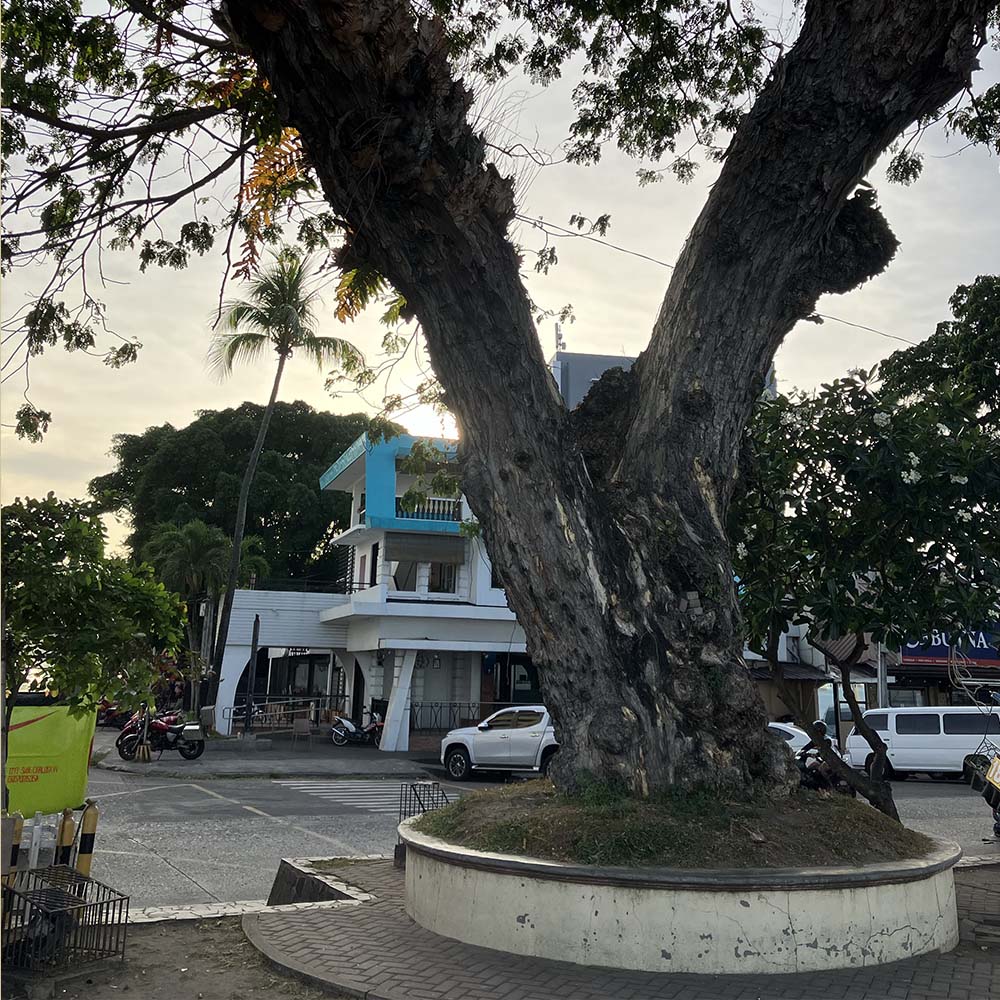
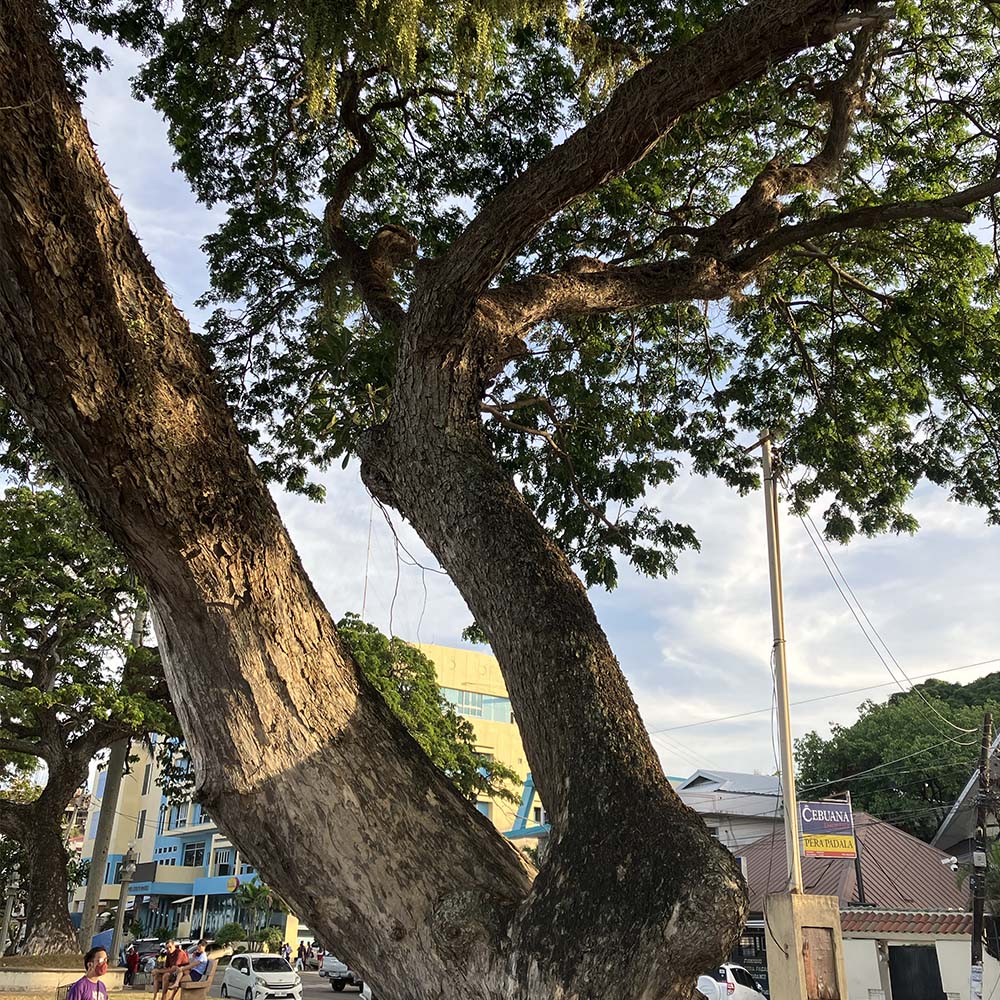
Walk down the Rizal Boulevard towards its northern point, and across Why Not? is a curiously shaped acacia tree, which has inspired many writers who come to Dumaguete. The acacia trees of Dumaguete are an iconic natural heritage of the city, and most of them are more than a hundred years old, a significant number having been planted by American missionaries at the beginning of the 20th century. [The Silliman campus itself is dotted with over 300 acacia trees.] An old story goes that an acacia planted at the Rizal Boulevard indicates the Protestantism of the family whose house that particular tree fronts.
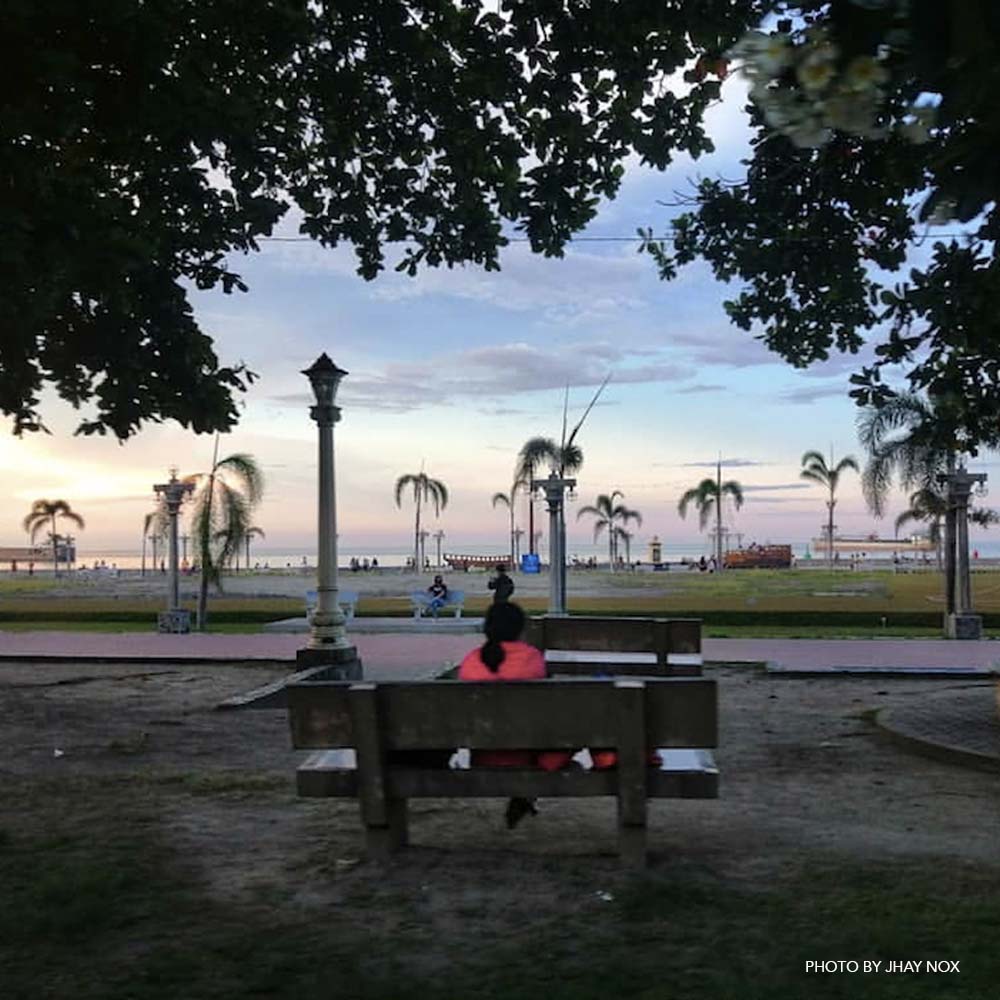
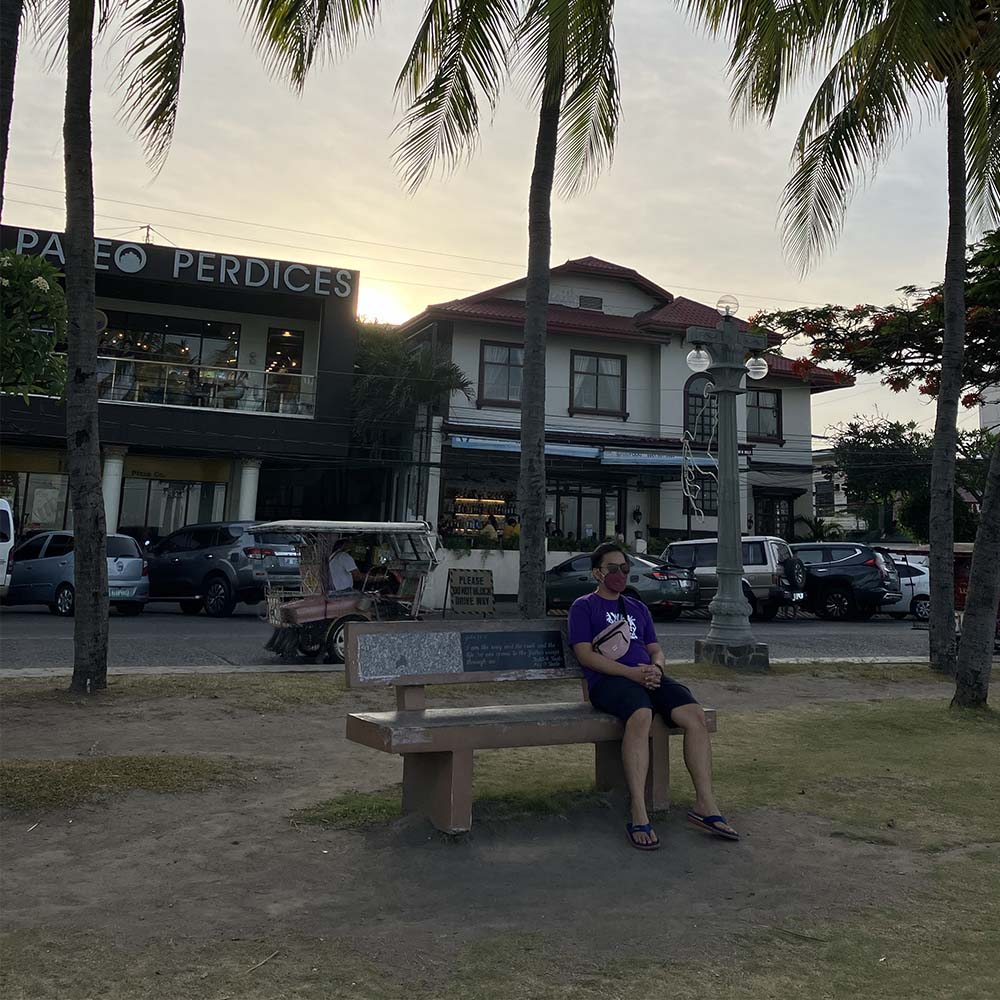
Walk down the Rizal Boulevard towards its northern point, and across from Paseo Perdices [formerly the Mariano Perdices mansion] and Sans Rival Bistro [formerly the Manuel Teves mansion], on the [almost] grassy area of the seaside promenade is a bench. There are actually many Rizal Boulevard benches, but this one is our favorite, and feels like the very bench from Villasis’s story. Officially the Paseo de Rizal, it was built in 1916 and currently extends at a length of 967 meters, from the Press Club to the pier [including the extended promenade]. It is named after Philippine National Hero, Dr. Jose Rizal, who was said to have spent a few hours along the stretch to stroll before departing for Dapitan for his exile. Presently, it has become the most sought-after, most romantic promenade of the city, where local social life practically begins. In Villasis’ story, a member of Dumaguete’s old guard who lives in one of the sugar houses falls into a tentative friendship [even love] with a prostitute who uses the Boulevard as her walking ground. What does this say about Dumaguete’s generational and economic divide?
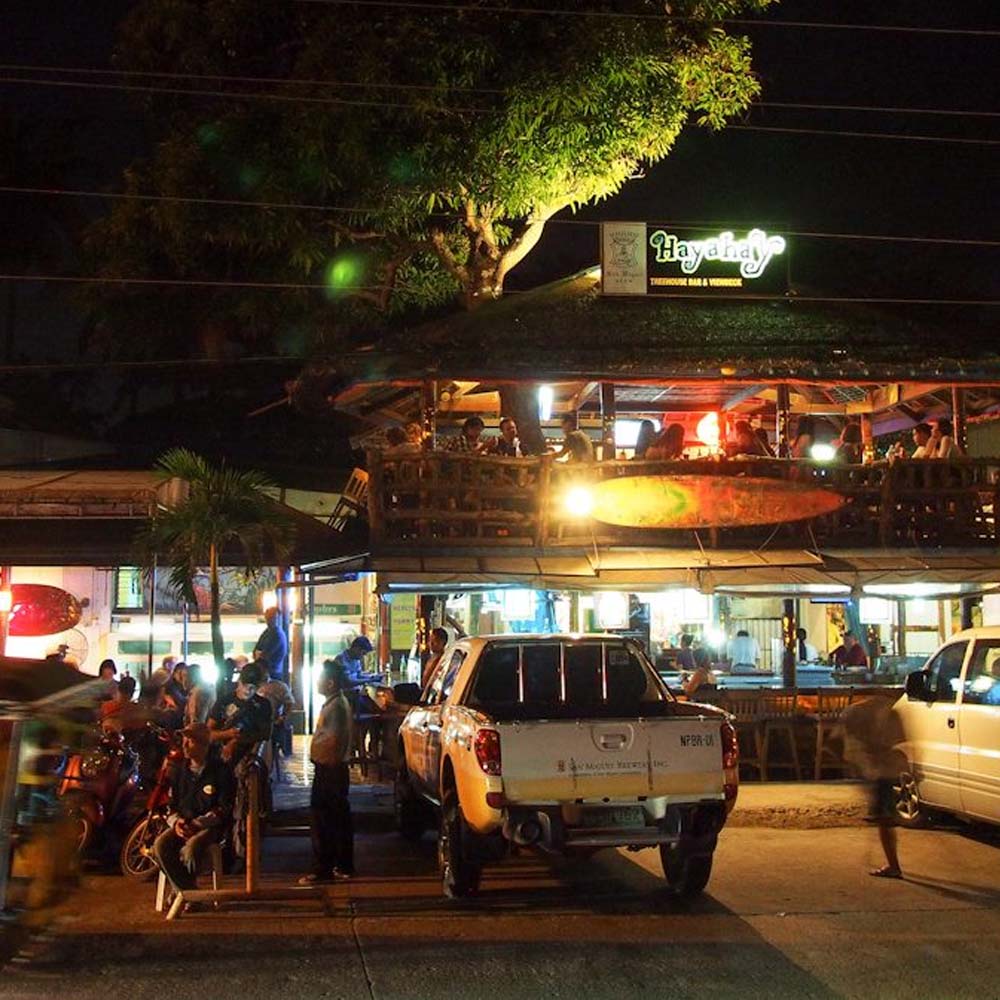
Disembark from your tricycle at Hayahay along Flores Avenue [which, for some reason, most locals used to call Escaño], fronting Piapi Beach [which, for some reason, most locals also call Escaño Beach]. “Escaño,” for many generations of Dumaguete youth, was “party central,” where you could park your car along the seawall, turn the car radio up loud, and party with friends. Hayahay, which includes Lab-as Restaurant, founded by the Fuentes family in 1988, is famous for its Reggae Wednesday, and also for being the “headquarters” for Dumaguete youth for most of the 1990s until the 2010s. Yu’s story paints a picture of this youth culture. What wild things did you do in Hayahay?
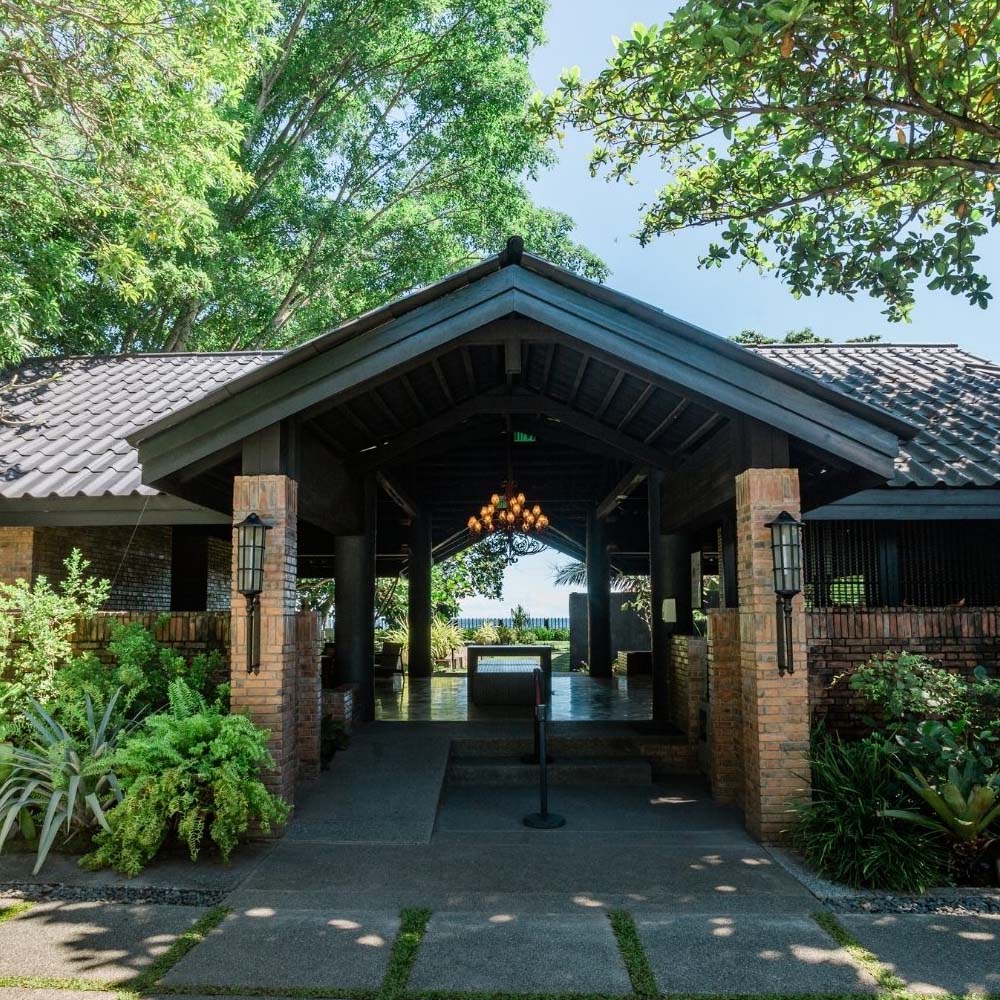
From Hayahay along Flores Avenue, walk northwards down the adjoining Escaño Drive, which has only been recently constructed and completed, reclaimed from what used to be a beachfront leading towards Silliman Beach in Bantayan. This will lead you to The Henry Hotel, a posh resort that used to be South Seas Resort, one of Dumaguete’s pioneering beachfront hospitality property. [In Villanueva’s story, it is masked as Seven Seas Resort.] Absent in The Henry Hotel is the dark vibe that pervades the story of a wife running away with her son from domestic strife. [What darkness does Dumaguete hide?] But while at The Henry, enjoy the offerings of its many restaurants, including Sans Rival, Si Señor, and Coffee Collective.
SPOT 12: THE OLD TIEMPO HOUSE AT AMIGO SUBDIVISION
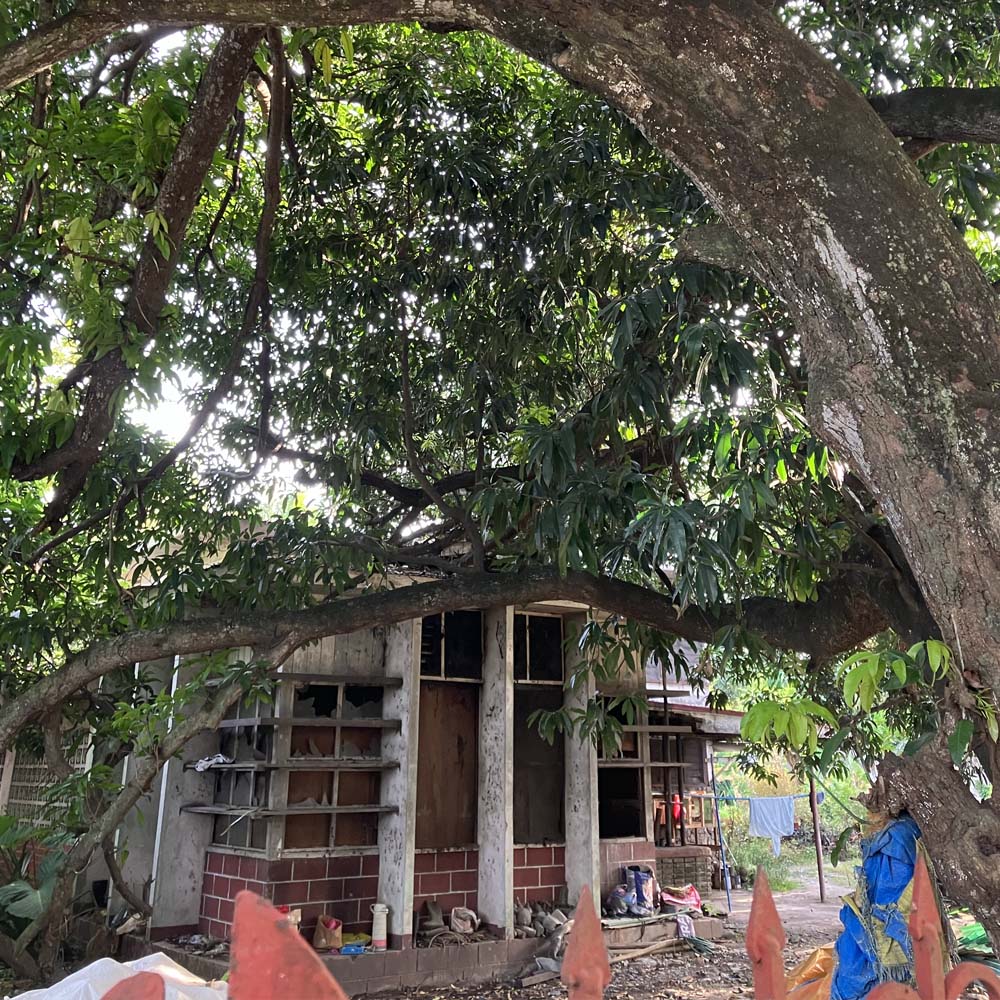
Exit The Henry Hotel from its Escaño Drive side, and choose either to walk or grab a tricycle to the next stop. We suggest walking, for the exercise, and retrace your steps back towards the intersection of Flores Avenue, Escaño Drive, and EJ Blanco Drive, and walk westwards down the latter. Turn left at the first road you will encounter, and you will have entered Amigo Subdivision, Dumaguete’s pioneering subdivision, established in the pre-war years by Mary Davis Amigo and her husband Norberto Noblefranca Amigo. Soon enough, you will come to the subdivision’s main artery. Turn right, westwards. Somewhere on the left, there is a gated property that used to be the home of Edilberto and Edith Tiempo, where they entertained [and taught] for many years, which they had to sell. Miraculously, the house is still intact, albeit in a dilapidated state. “Bonsai” was written in this house, and touches on personal items from the Tiempos’ lives.
SPOT 13: IN TRANSIT, ON BOARD A DUMAGUETE TRICYCLE
From the western entrance to Amigo Subdivision along Hibbard Avenue, hail down the ubiquitous Dumaguete tricycle [which is also locally known as a “pedicab,” albeit a misnomer since the cab does not run on pedals, but is attached to a regular motorcycle]. The cab goes about town with its distinctive three-wheels, and is the most popular form of public transportation in Dumaguete. Its size makes it arguably one of the biggest cabs of its kind in the country. There are currently about 2,500 tricycles plying the streets of Dumaguete. The regular fare, post-pandemic, is 15 pesos per kilometer. Read Gamalinda’s short poem while on transit. Do Dumaguete’s roads “crawl on [their] bellies to the sky” still?
SPOT 14: OUR MOTHER OF PERPETUAL HELP REDEMPTORIST CHURCH
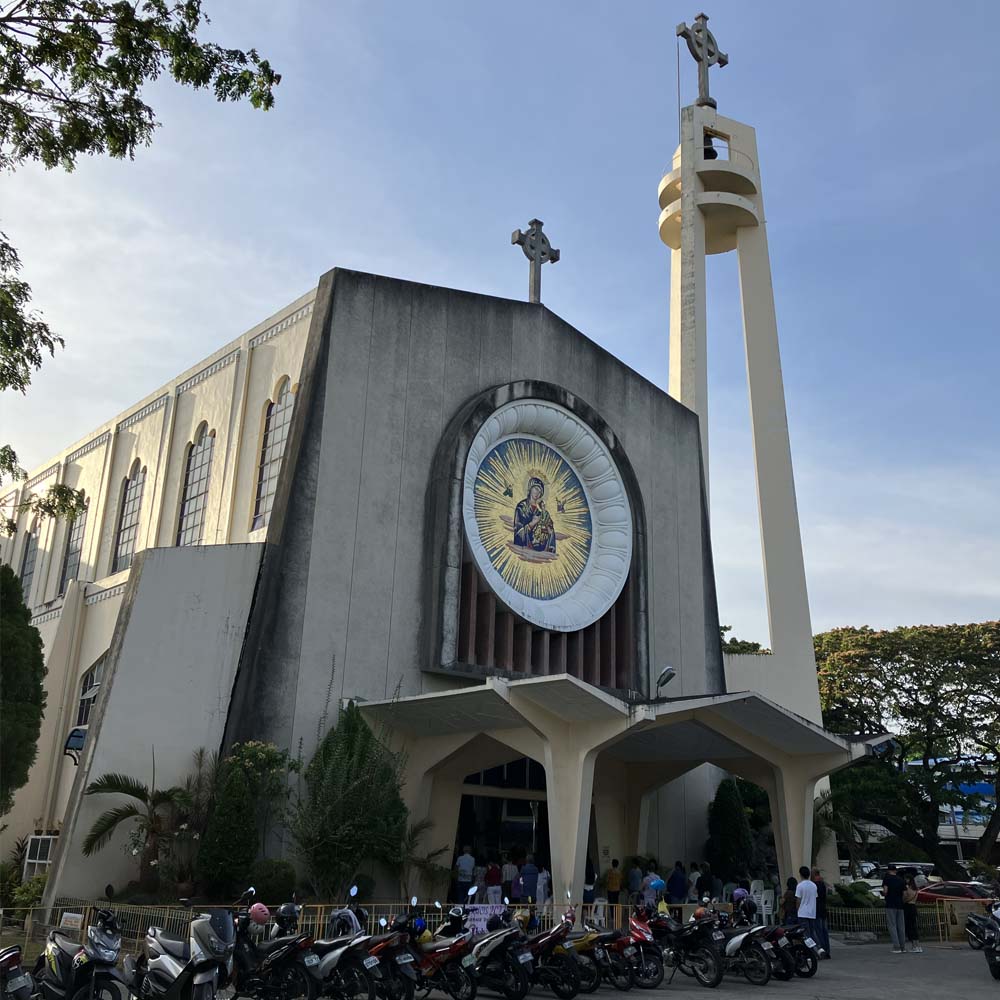
Disembark from your tricycle at the Our Mother of Perpetual Help Redemptorist Church, which is accesssible from Jose Pro Teves Street [formerly Cervantes Street] via San Lorenzo Ruiz Drive, which skirts the church’s compound. The church was inaugurated in 1970, but started its congregation at the then Our Lady of Perpetual Help Chapel at the nearby Manuel L. Teves Memorial Hospital compound in 1958. The Redemptorist Church famously put out a statement to toll its bells when Fr. Rudy Romano was abducted by military forces at the tail-end of the Marcos regime for his activism, never to be seen again. Those who grew up in Dumaguete in the 1980s would remember the ringing of these nighty bells.
SPOT 15: THE PARK AT THE SILLIMAN UNIVERSITY MEDICAL CENTER ALONG ALDECOA DRIVE
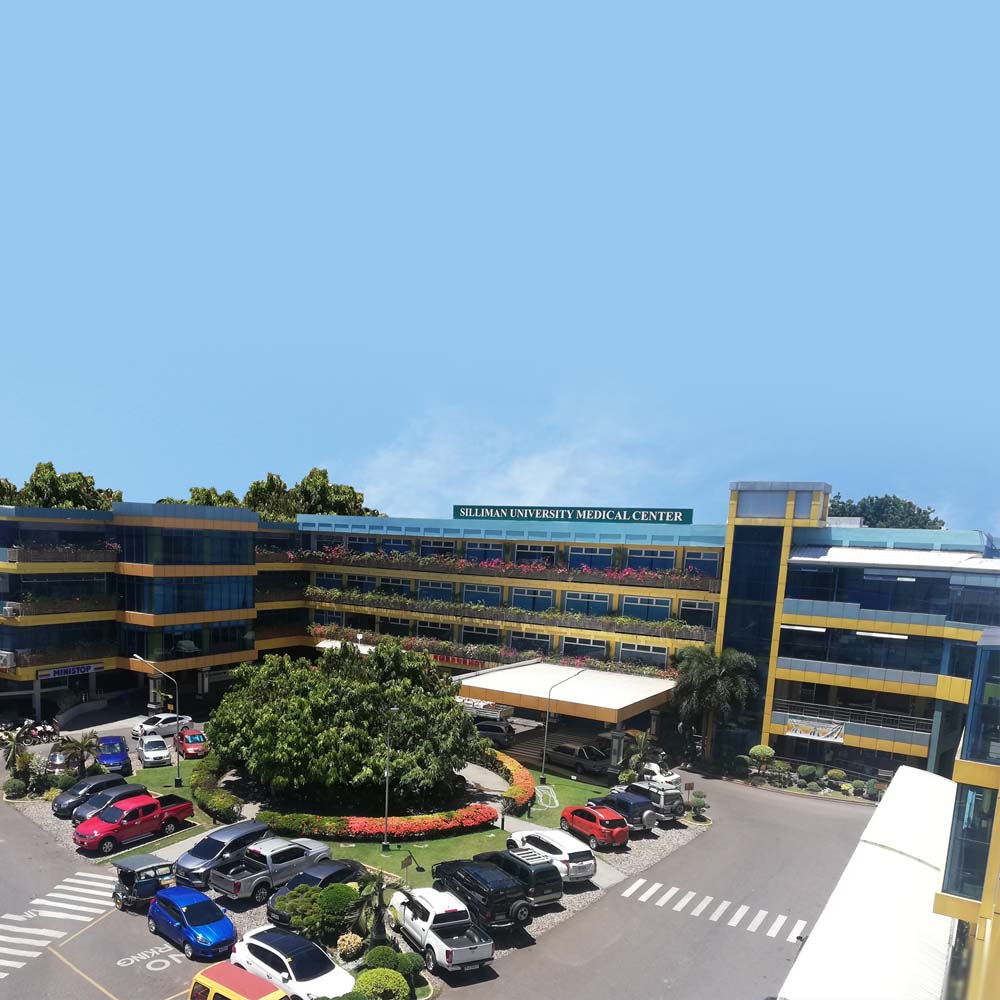
From the Our Mother of Perpetual Help Church, grab a tricycle and go to the Silliman University Medical Center. For our purposes, let’s use as our stop the small park at the very center of the hospital compound. SUMC is an independent sector of the university, and grew out of the Mission Hospital first established along Hibbard Avenue [in the building now known as Katipunan Hall] in 1915, which served the community for more than one hundred years. The new one along Aldecoa Drive was built in 1974, and finished in 1976, and boasted of the first elevators in the province. In one part of Aquino’s story, a young man is confined in the hospital. How many stories are there in the actual story?
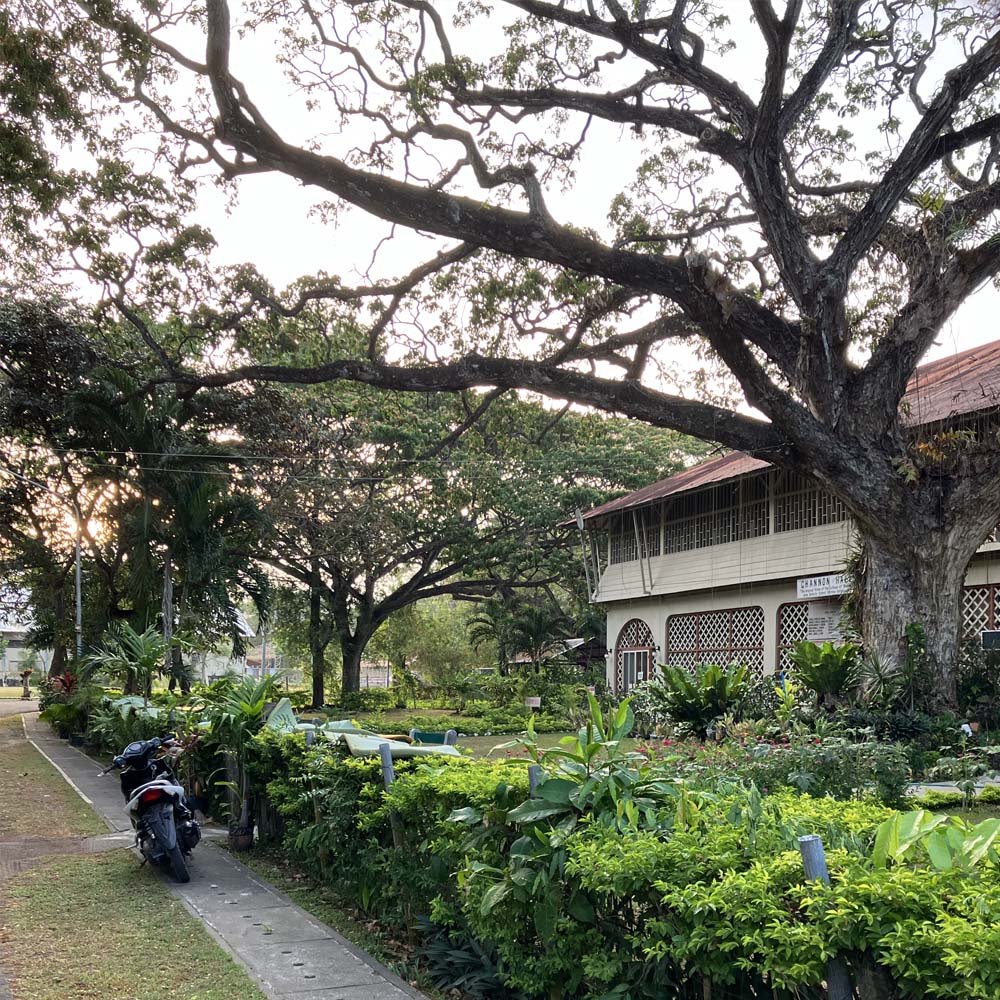
From SUMC, go a bit eastward down Aldecoa Drive and proceed to the northern entrance to Sillliman campus in a place everyone colloquially calls Laguna. The Laguna road is a bit of a long walk until you reach a second gate that takes you into the main campus. Turn to the immediate left, towards the dorms, and follow the path that leads to the back of Chapel of the Evangel. Channon Hall is the old building beside Hibbard Avenue, one-time torture chamber of the Japanese during World War II. The large acacia trees nearby also served as hanging trees for condemned prisoners. Get a nightmare. In this excerpt from Coscolluela’s play, a middle-class Dumaguete family starts feeling the personal ravages of World War II in the city. How much do you know about the Japanese Occupation in Dumaguete?
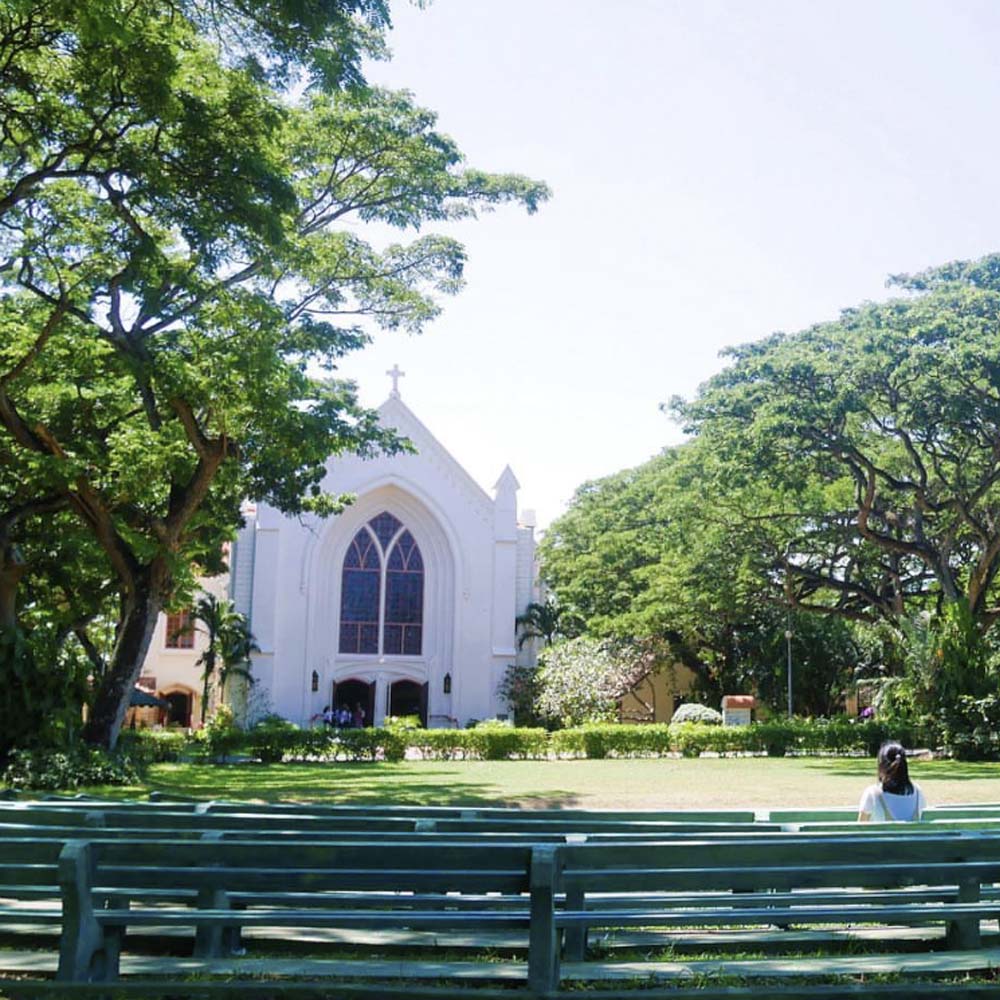
From Channon Hall in Sillliman campus, cross the wide expanse of the Ravello Soccer Field towards the Luce Auditorium, and walk the concrete path going southwards along the entire length of the Roman Yap Road, which terminates in one of the drivethroughs that service West Quadrangle, the Amphitheatre, and Silliman Church, which was completed in 1949 and is the built testimony of Silliman’s American Presbyterian origins. Sitoy’s novel, which could be about Dumaguete as Donostia, sets a tense confrontation scene in the university church. Has your faith ever been rocked by doubt?
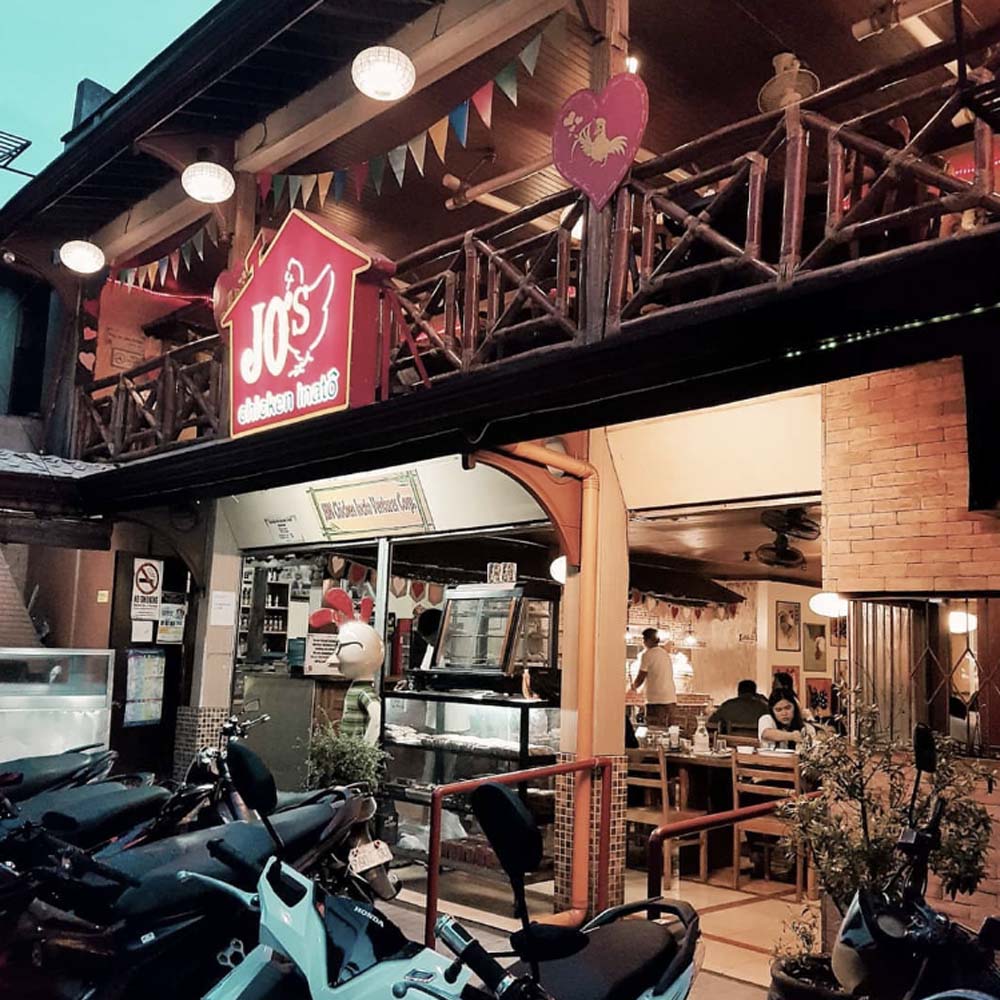
From Silliman campus, exit through the portals at the head of Hibbard Avenue and turn to the left, towards the sea, along Silliman Avenue. Right near the intersection, you will find Jo’s Chicken Inato, a heritage restaurant in Dumaguete City founded by Josephine and Jesse Ng in 1985 to introduce Dumaguete’s equivalent of Bacolod’s chicken inasal, which is the inato [or “ours”]. It started as a cake house, but later evolved into a roasted chicken empire that speaks much of the locals’ love for chicken. Casocot’s story is a reflection of this love, centered on the inato. While you’re here, eat a pecho.
SPOT 19: EL AMIGO/CAFE MEMENTO ALONG SILLIMAN AVENUE
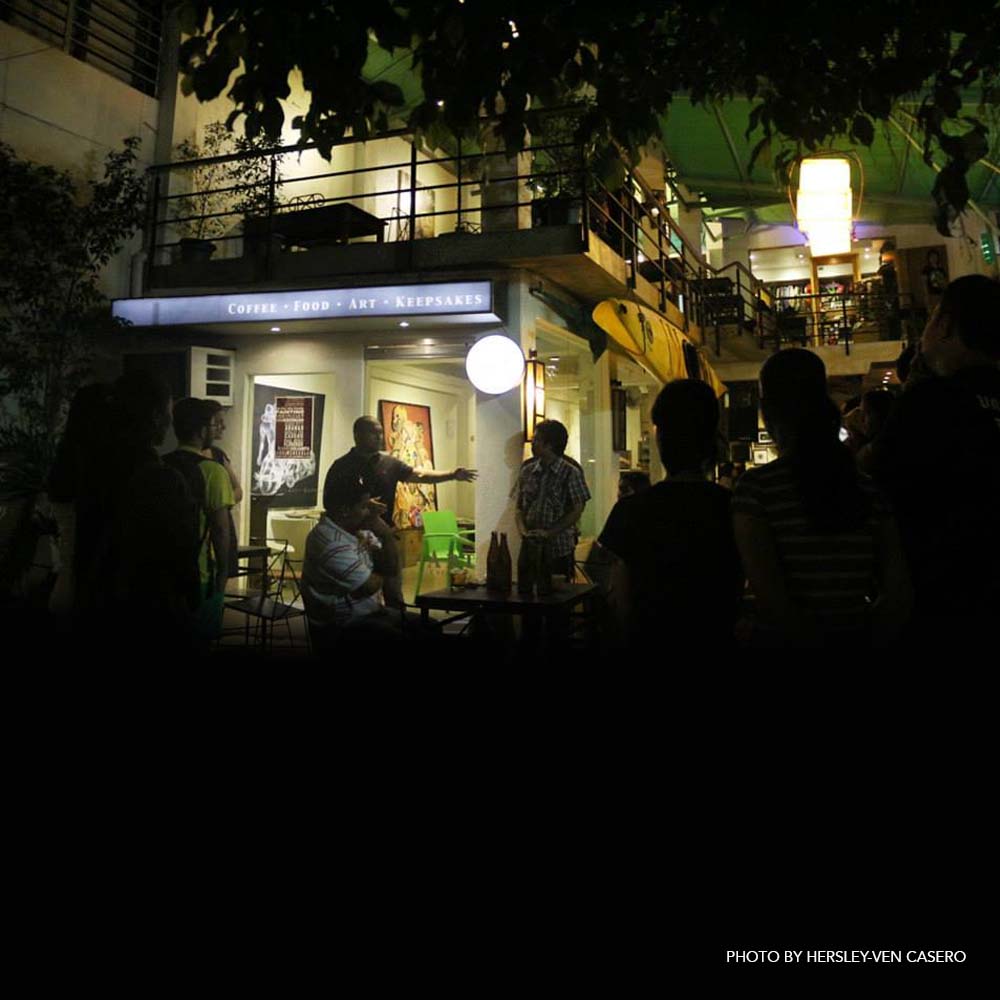
From Jo’s Chicken Inato, walk towards the east, towards the sea, along Silliman Avenue. Just a stone’s throw away from the corner of Rizal Avenue, you will come across a bar called El Amigo, which has a smaller coffeeshop/gallery inside it called Cafe Memento. This is owned by the visual artist Babbu Wenceslao, the son of the poet Merlie Alunan. Starting in the 2000s, this was the hangout of many of the city’s young artists, and particularly the poets that come to Dumaguete every summer. Pastrana’s poem is a story of a summer love. Have you ever fallen for the same kind of magic in Dumaguete?
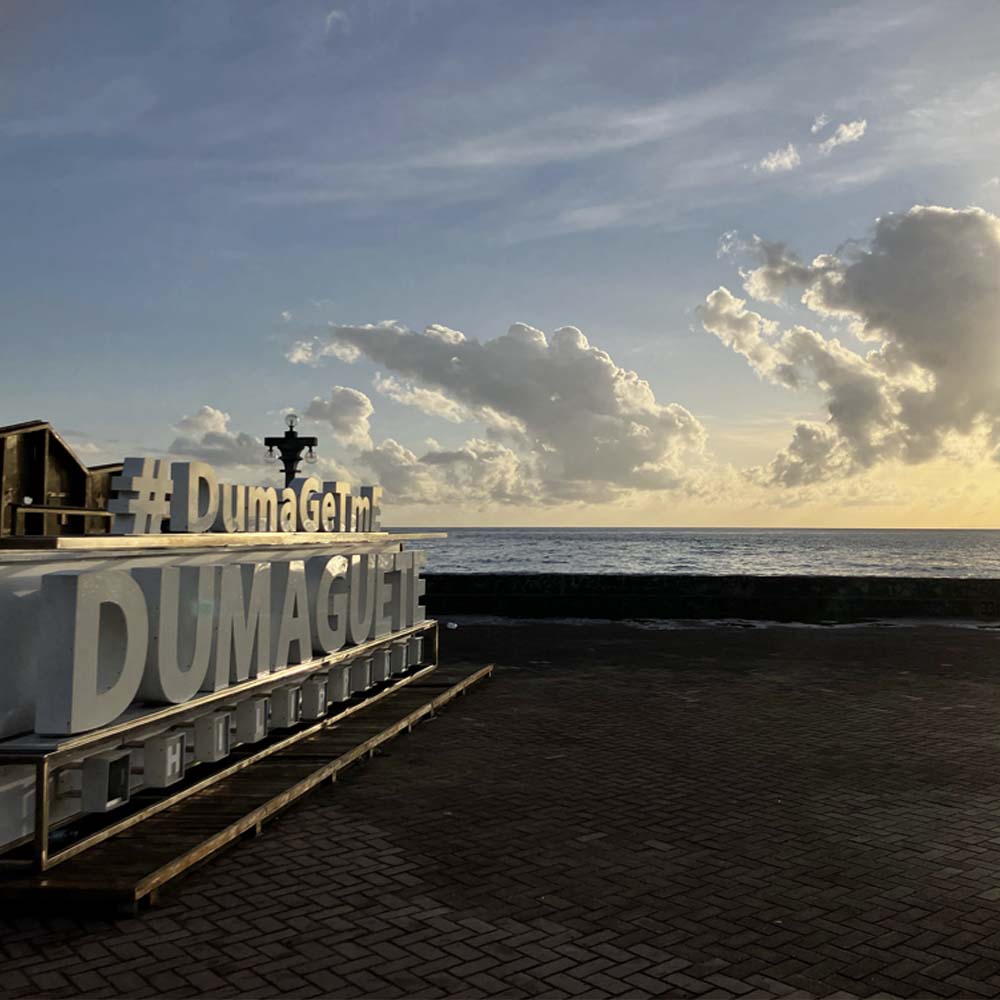
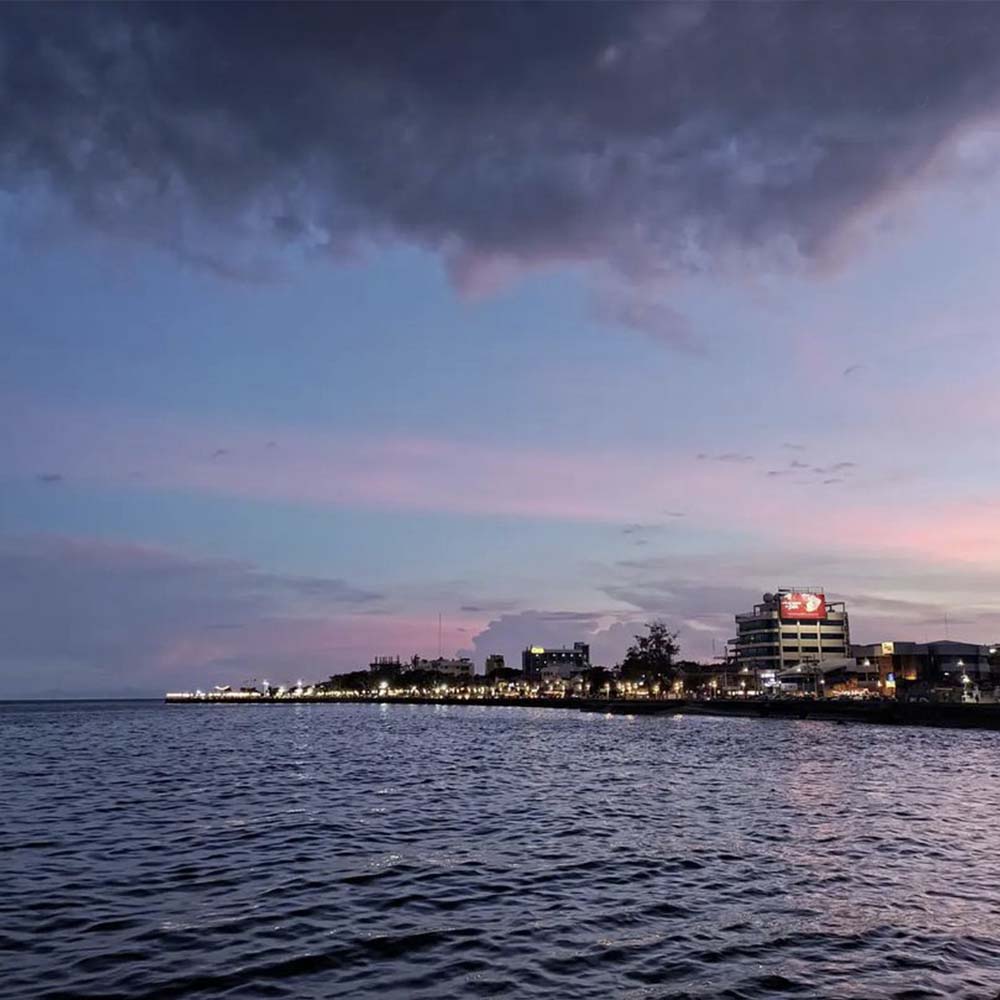
From Cafe Memento/El Amigo, walk along Silliman Avenue and go towards the sea, and cross Rizal Avenue to enter Rizal Boulevard once again, this time with a view of Silliman Hall, the oldest building in Silliman campus. Go to the area which is known as Pantawan Uno. “Pantawan” is the Bisaya word for “window,” and this square is just that: the window into Dumaguete, complete with a signage for tourists to take photos in. Sit by the seawall. Contemplate the view. Think of Montes’ love/hate letter to the city. Do you feel the same way?
From the Pantawan Uno of the Rizal Boulevard, where the Dumaguete signage is located, walk the brick pathway towards the northern end of the paseo, which terminates at the entrance of the Dumaguete Pier. Go to the Visitor’s Center, which contains information about Dumaguete for tourists. The Visitor’s Center also has a balcony which gives one a good view of the city, particularly the Rizal Boulevard area. It is a site for both welcome and goodbye. Read Evasco’s poem while looking at the city. Imagine that the farewell it talks about is yours.
Sometime last year, I published an essay on Rappler that chronicled the difficulties that the Martial Law years wrought on Negrense lives, especially with its specific stranglehold on the sugar industry that remains totemic of Negros society — but I wrote it the only way I knew how: in the painful mapping of the upheavals it wrought on my family, and how we lost everything because of political and economic machinations we never really knew had us in their claws. I wrote about our descent to poverty, and the hunger of those days. I wrote about my father, and how he lost his pride, which he never recovered from. And I wrote about my mother, and how she braved through the upheavals with her sense of survival and enterprise. In the final analysis, I can truly say that I understood fully the overarching social reality of my world at that time via the ways my family’s lives were reshaped and changed. The newspaper chronicles may have their facts and their numbers, but the pains and the joys have an extra edge when we see them through the lens of family drama.
I reflect on that because the dynamics of familial relationships—the jagged joys and the recurring recriminations—is the pattern that somehow emerges in this issue of Buglas Writers Journal, especially in our prose section. Here, we have writers trying to understand specific social realities in the ties that bind [and unbind] them with family members.
Two pieces of fiction featured here are the top winners of the Palanca Awards of 2022, and they set the stage for the theme of family this issue is somehow about. Rayboy Pandan’s Bittersweetland, which won the Grand Prize for the Novel, follows a haunted New York exile who comes home to Bacolod to attend a fete celebrating his politician father. In the excerpt we have chosen [which is Chapter 2 from the manuscript], we see the character preparing for the homecoming, and steeling himself from the flood of memories evoked not just by the familiar landmarks of home, but also by the reconnection to family a homecoming always entails. The excerpt provides the backdrop for the novel’s ultimate dilemma: his father, having announced his intentions to run for public office, is assassinated, and this puts our hero into a tailspin that involves not just family drama but also cruel Bacolod politics—and because the novel is set in the early 1980s, also the looming sugar crisis and the slow disintegration of the Marcos regime in the wake of the assassination of Ninoy Aquino.
I have also chosen to include my short story, “Ceferina in Apartment 2G,” which won First Prize in the Palanca, because it also chronicles a very specific kind of family dynamics: in this Los Angeles-set story, an aging mother, newly migrated to the United States, tries to make her new home feel more familiar by cleaning every nook and cranny of her son’s apartment, even if she is besieged by homesickness for Hinoba-an [a town in southern Negros], the ghosts of her own troubled past, and the specter of not being aware of her son’s homosexuality.
This gay theme is also touched on by Elsa Martinez Coscolluela’s short story, “After This, Our Exile,” which won Third Prize at the Palanca Awards in 1972. Told from the point of a view of a girl adopted by a landed Bacolod family, it chronicles the various personal tragedies that befall this family—all of them springing from the patriarch’s raging machismo. This invariably destroys the lives of everyone in the family, including the scion who becomes an activist who turns his back on his sugar roots after suffering the years of indignities wrought on him by his father who is disappointed by his “effeminate” ways. The story is also an indictment of Negrense society, and how it coddles societal ills by its acceptance of dangerous machismo, as well as embrace of a worldview that treats plantation workers—the sacadas—as vermin to be constantly put in their place.
This repudiation of machismo is also evident in Jose V. Montebon Jr.’s short story, “Bottle Full of Smoke,” which won Second Prize at the 1954 Philippines Free Press Short Story Contest. In this painful tale of family strife, a boy witnesses the abuses heaped by his alcoholic father on his mother—and proceeds to do the only thing he could to even the pain.
In Alana Leilani Cabrera-Narciso’s creative nonfiction piece, “Psalms,” we don’t get a family wrecked by an abusive alcoholic father—but nonetheless, it is a tale about a young daughter coming to terms with her father’s unbending strictness that governs their spiritual life, and how this is tested by a freak accident which changes their lives.
Not everything familial in this issue is painted in strife and struggles. In Albertha Lachmi Obut’s children’s story, “The Moon has Many Shapes,” we get a reprieve: it is the story of a young boy who lives in a world that only knows Day, but hears of a world that is somehow governed by Night. One day, in his reverie about that unknown world, his grandfather comes along to give him a story that may fire up the young boy’s courage to pursue what is not known.
The poems in this issue, however, stray from the thematic thread of the prose pieces. In F. Jordan Carnice’s suite of two poems, we get a mediation on garden life informed by the long lockdown of the pandemic, and we get a play at definition for a word that promises a multipliicity of meanings. In Jhion Jan Navarro’s “Kay Tuman ka Gabok sang Lawas,” we get two Hiligaynon binalaybays that maps emotional geography of a city. We get the same treatment in Simon Anton Diego Baena’s “Orison,” a short poem that that traces the phantoms of a rainy day in his hometown of Bais—a yearning for meaning that is also reflected in Junelie Velonta’s “Bright Lights on the Water’s Surface,” which does the same for Dumaguete with the persona confronting the dark waters off the Rizal Boulevard.
Sometime in 2008, I had the fortune to be asked to form and moderate LitCritters Dumaguete, a fledgling group of young writers in Dumaguete — all of them students studying at Silliman University at that time — who were keen on learning about creative writing in depth, and were willing to go to great lengths to produce stories fit for national publication. It was a local branch of LitCritters Manila, a group led by Dean Francis Alfar, which was known for following a strict workshop and reading schedule, like so: every weekend, usually on Saturdays, the group would meet and discuss three or four stories by known [and some unknown] authors, and try to see what made them work [or not work]. And then, after three weekends of reading and critiquing stories, each member of the group was required to produce their own short story — to be workshopped by all the rest on the last Saturday of each month. This period, which lasted until 2012, was probably the most productive time I had writing-wise, and many in the Dumaguete group would go on to publish their works in national magazines. Many others [both in Manila and Dumaguete] would also win national awards for our efforts. It remains an unequalled time in terms of personal literary production.
One such story that saw national publication was Justine Megan Yu’s “Sweet Baby.” This story came about because of a writing challenge we posed to the entire group: they had to write fiction whose sensibility was the complete opposite of their own. One member of LitCritters Dumaguete hated domestic realism with passion, so he was asked to write one. [He made a refrigerator fall on his protagonist, just to end the wretched exercise.] Another one was of the religious sort, so he was asked to write a story that was in complete negation of God. I have never been known for my sense of humor, which makes me uncomfortable with writing comic stories — so the group challenged me to write one. [My effort, thankfully, was later published in Philippines Graphic Magazine.] Justine was famously a fervent feminist, and so she was asked to write a story that followed what we called a “male chauvinist pig.” She demurred, but she nonetheless accepted the challenge. The story she produced was phenomenal for its stark rendering of a character we knew she hated, and we encouraged her to submit it for national publication. A few months later, the Philippines Free Press accepted it.
This made me realise that sometimes going outside one’s comfort zone in writing can make for the best literary exercise. That “comfort zone” may be defined by what we believe, or what we know, or what we are used to in terms of style. You may call this your “voice.” Admittedly, many of my own stories are products of what I believe in, and what I know, and what I am used to in terms of narrative style — but I also find that sometimes going against my innate writing instincts, governed by all three, usually give me stories that are surprisingly fulfilling for me, although the effort in crafting them is hardly easy.
What’s on the other side of what we know, what we believe, and what we are comfortable with?
Justine Megan Yu‘s short story “Sweet Baby,” about an unrepentant Romero in Dumaguete forced to deal with an unexpected twist in his love life, is certainly a testament of what can be achieved when one considers the above question fully.
Bacolod writer Nicolas Lacson‘s “The General” also does the same: he confronts a towering family figure he barely knows, and sees that the ghost of the past may still haunt, but they are irrevocably gone. What’s on the other side of legend? Dust.
In Dumaguete writer Francesca Flores‘ “Multiverse,” we get a science fiction twist to a tale of amnesia and “lost” love, and posits this dilemma: what’s on the other side of another life?
And because it is his 98th birth anniversary on September 22, we have decided to include Duamguete screenwriter Cesar Jalandoni Amigo‘s short story, “Rain Without Meaning.” It is reprint from the pages of the 1946 issue of The Sillimanian Magazine. What’s on the other side of devotion and expectation? Hatred and disappointment, Amigo tells us in this story about a daughter, who could never measure up as a pianist to her exacting elderly father.
In our collection of poetry for this issue, we begin with two poems by Cesar Ruiz Aquino. In “Illuminatus,” Aquino derives playful dilemma from an interview with Negros Oriental’s Father Eleuterio Tropa, a former Catholic priest turned founder of an environmental cult he named The Lamplighters. [He died in 1993, and is buried in Zamboanguita.] What’s on the other side of your professed beliefs? Secrets you can never tell the world. And then in “Sun,” Aquino does his occasional exercise in revision of an earlier poem [this one has various iterations in previous publications]. What is the other side of “finished”? A poet always on the side of tinkering.
In “King of Comedy,” Bacolod poet Hezron Pios tackles one magnificent trapo of a politician — the offending person goes unnamed in the poem, but is not difficult to deduce — whose ungodly shenanigans pains the poet, who unleashes a magnificent tirade in this piece. What’s on the other side of bad politics? A lost dream.
In “New Key,” Dumaguete poet Lyde Sison Villanueva takes the metaphor of a key and fills it with rumination on memory, geography, even grief. What’s the other side of a jammed lock? A spare key that does not want to be useful.
For our essays in this issue, we are reprinting from the pages of Silliman Journal, Niccolo Rocamora Vitug‘s impassioned reconsideration of the legacies of Dumaguete writers Edilberto and Edith Tiempo and the legendary workshop they co-founded in 1962 in the light of recent criticism about their work [in English] and the claim that the Sillliman University National Writers Workshop is problematic because of its alleged ties to American imperialism, its supposed adherence to the tenets of formalism, and its insistence on only considering works by Filipino writers in English. The other side of all these is nuance.
Finally, in celebration of Amigo’s 98th birth anniversary, I have written an appreciation of the Dumaguete filmmaker and writer. He was acclaimed and well-awarded in his prime, and produced many great works that have contributed considerably to Philippine cinema and literature — but he is sadly mostly forgotten now. Only last September 2, a restoration of one of the films he scripted, the Gerardo de Leon classic The Moises Padilla Story, was screened by the Film Development Council of the Philippines in Quezon City. This was part of the celebration of the Philippine Film Industry Month this year—and the organizers forgot to invite Amigo’s family to the screening. This second issue of Buglas Writers Journal aims to rectify this cultural amnesia by devoting space in remembrance of Cesar Jalandoni Amigo.
The idea for this journal was conceived in 2017, right around the time K-12 was at the height of being implemented by the Department of Education, and there was a sudden clamor by educators for literary materials that came from their specific regions, especially those written in the Mother Tongue. It was a good time to introduce an online literary magazine that focused on the literary works of local authors — but it took five more years before the idea would finally come to fruition. The pandemic and its uncertainties certainly helped in the eventual realisation of this effort, but it was the desire to showcase the works of writers from Negros and Siquijor that was the biggest force. It was a much-needed corrective to the lack of local literary publications.
I’ve always been fascinated with literature that comes from my region of the Philippines, specifically both provinces of Negros Island [and also Siquijor, which used to be part of Negros Oriental]. In 2003, when Vicente Garcia Groyon came out with his first novel The Sky Over Dimas [which won the 2002 Palanca Grand Prize], and Rosario Cruz Lucero followed suit by publishing her astounding sophomore collection of award-winning short stories under the title Feasts and Famine: Stories of Negros, I found myself wondering what exactly it was about Negros Island that attracted and stirred so much imaginative storytelling.
Barring the [almost] hegemonic boundary-setting to the geography of the Filipino imagination as something concentrated only around the slums, business districts, and posh subdivisions of Manila, Negros [I think] comes in as good alternative as the place by which we have come to situate the creative Filipino. In films alone, Peque Gallaga [of Bacolod] have given us the quintessential Filipino epic Oro Plata Mata [1982], a cinematic masterpiece about Negrense hacenderos during the Japanese occupation in World War II. That film is still arguably unequalled in terms of scale and ambition—except perhaps by Ganito Kami Noon, Paano Ngayon [1976], directed by National Artist for Film Eddie Romero, which as a film makes a conceit of trying to define what it means to be a “Filipino.” Although Ganito Kami Noon is not set in Negros, Romero [of Dumaguete] has also given us other homebound masterpieces, such as The Passionate Strangers [1966], a film noir set in Dumaguete, and Kamakalawa [1981], an epic tale of prehistoric Philippines which people say is set in old Negros [or the pre-Hispanic Buglas]. But even if it was not Buglas, Kamakalawa was filmed in Negros Oriental anyway, employing locals as supporting players and extras, and employing Oriental Negrense backdrops to flesh out pre-colonial Philippines—from the rolling plains of Bundo in Siaton to the green niches and rivers of Amlan.
These are films. Literary titles about Negros, on the other hand, constitute a small sub-genre of Philippine literature. There are so many novels, short stories, poems, essays, and plays set in Dumaguete, Bacolod, and the towns and cities of both provinces, as well as Siquijor—and not just those written by local writers. It also includes literary pieces written by other writers not native to the region who have somehow been smitten by our specific Visayan airs, entranced or curious enough about our lives here to put their impressions down on paper. [Not always in the positive light, of course, but that’s part of the fascination.] Which is why tackling this very fascination makes for a great theme to constitute the very first issue of Buglas Writers Journal.
So what is it about Negros that tickles our fancy? Perhaps it is the Tropical Gothic [Nick Joaquin’s term] nature of the place—all these haciendas, old acacia trees, old churches, and old Spanish and American colonial houses quickly serving as beacons to ghosts of a very write-able past. Perhaps it is the intricate codes and manners of the Negrense social hierarchy—all those sugar aristocrats with their beautiful sons and daughters, and their mad, eccentric lives, and all the hungry hangers-on and downtrodden masa that surround them. Perhaps it is the sheer beauty of the place—think Silay City, for example, with its gilded mansions, or think the Rizal Boulevard of Dumaguete with its “sugar houses.” Perhaps it is Dumaguete’s intellectual air, and Bacolod’s snobbish appeal. Or perhaps it is the exquisite blend of the urban and the rural which Negros shares only with a handful of other places in the Philippines.
Whatever it is, the Negros in our minds has always proven to be intoxicating … and readable.
As previously mentioned, in literature, the list of stories, poems, and plays about Negros runs long, and for this maiden issue of Buglas Writers Journal, I have chosen a sampling of literary pieces which, for me, provide a rich enough tapestry of life in [and history of] the Island. Consider the selection a sampler—a meager one at that, since there are many other pieces not included which could also very well do the job of providing a map of the imagination of Negros.
The fiction, poetry, drama, and essay in this issue of Buglas Writers Journal are beguiling for the stories they tell, but I’ve also chosen them because they also provide the reader a great sense of place — virtually providing us a survey to the Negrense world in all its varied colors and textures, its smells and airs, its idea of joy and dread.
One of the short stories that do this best is Bobby Flores Villasis‘ “Menandro’s Boulevard,” which, beyond its story of a fragile friendship between two unlikely people, gives us a literal and emotional map with which to understand the stretch along the Dumaguete shores known as the Rizal Boulevard, and the denizens who live there in their so-called “sugar houses.” Villasis, who has written extensively about Negros Oriental in his many award-winning stories and plays, is probably Dumaguete’s James Joyce: his Suite Bergamasque, where our story is collected, is the city’s version of Dubliners, but concentrated on a single city street.
There are also pieces that sometimes go beyond the literal in their rendering of place, and make that place a stand-in for the symbolic. Such is Marianne Villanueva‘s “Dumaguete.” Here, the famed Bacolod writer trains her eyes on the capital city on the other side of the Island, and makes it emblematic of a family’s unraveling: for a mother and son pair “on the run” from Bacolod, their self-imposed exile to Dumaguete becomes it a dark, claustrophobic place that threatens with [perhaps imagined] dangers. The thrill of the story is delicious, and I love seeing Dumaguete rendered this way.
The National Artist for Literature Edith Lopez Tiempo also regularly sets her stories and novels in familiar places from her very rich life—sometimes some small generic town in Mindanao, and sometimes the Nueva Ecija of her childhood. But in many of her stories, the spirit of Dumaguete is endlessly evoked, even if they are camouflaged by some other name. In her last novel The Builder, however, she drops all pretense of cover-up, and states clearly that her murder mystery is set in Dumaguete, with ample mentions of nearby towns of Sibulan and Valencia. By the story’s end, we find the protagonist in the middle of Tañon Strait, battling both revelation and spiritual horror. But my favorite Edith Tiempo story is the wartime tale, “The Black Monkey,” which won third prize in the first ever Palanca Awards held in 1950. In this story, a housewife—on the run from war-ravaged Dumaguete—is forced to fend for herself in the jungles of Negros Oriental because of an injury that makes her a liability in their small community of evacuees in the foothills of Valencia. Even while the Japanese occupation forces advance deeper into the jungles in search of their like, her husband builds her a little hut by a cliff where she could stay and be away from the rest of the camp—with only a gun her husband has given her promising her a semblance of protection. And then the black monkeys come to disturb her.
Edith Tiempo’s husband, the equally legendary Edilberto K. Tiempo, also set many of his stories in Negros Oriental, but for this issue, I’ve chosen the title story from his 1992 book Snake Twin and Other Stories, simply because it weaves a magical blend of scholarly pursuit and folk superstition common in the region, while making quick stops not just in Dumaguete, but in the nearby town of Sibulan, as well as Siquijor. Is the folk belief of people born with snake twins true? The story explores the anthropological meanings of that belief, and finds itself delving even deeper—including a malevolent political reality.
Their daughter Rowena Tiempo Torrevillas’s harrowing domestic chronicle in “The Fruit of the Vine” is also a fine example of a Negros tale, which involves the domestic [and financial] travails of local sugar planters — a commonality the story shares with Vicente Garcia Groyon‘s “Justo and My Father’s Car” [a delicious, Whartonian exploration of the foibles of Bacolod high society] and Rosario Cruz Lucero‘s “Good Husbands and Obedient Wives” [a delicious, Jamesian exploration of the misdemeanors of the Bacolod middle class].
In “Valencia Drive,” the late Tanjay writer Ernesto Superal Yee renders the story of a young writer driving from Dumaguete to the hills of Valencia — and the whole ride becomes a tribute to the Tiempos who are the author’s mentors. It lends this truth: sometimes Negros is not just place; it’s also the people — especially if those people are as accomplished as the Tiempos.
There’s more to that Negrense world-building in the poems, essay, and play featured in this issue. In Augurio M. Abeto‘s Hiligaynon poem “Panay kang Negros,” we get an exercise of the historical and sociological kind as the poet examines the pre-Spanish migration of Panay people into the island then known as Buglas, and the culture and community building that soon followed. In Elsa Martinez Coscolluela‘s “Cuernos de Negros,” we get an ode to the mountain range that separates Negros Island into its two component provinces — this time rendered as a memory piece of harvest days and remembrances of family. In Myrna Peña-Reyes‘s “At Camp Lookout,” we get a mournful confessional of a Dumaguete denizen away from the hubbub of city life while enjoying a break in the famed spot high up in the hills of Valencia, which overlooks the entire city. In Anthony Tan‘s “To a Tree Near a Boulevard,” we get an ode to the nature that defines the Dumaguete shoreline. In National Artist for Literature Gemino H. Abad‘s “Casaroro Falls,” we get the story of a family hike to the famous waterfalls in Valencia, which becomes an examination of youth, ageing, the rejuvenation made possible by nature, and the waning search for adventure as we grow older. In my own essay, “A Field Guide to Burning the Town Red,” I examine the night life in Dumaguete, and how it has evolved over the decades. And in Mike Gomez‘s “Tirador ng Tinago,” we get an excerpt from his Palanca-winning play which satirises Filipino action films in its take of small-time hoodlums in the Tinago slum of Dumaguete.
I hope that by the time you finish reading every piece in this issue, you will come to understand how each of them somehow give light to what it means to live in Negros Island [and Siquijor] — and why this place, home to most of the writers featured here, is the wellspring of much of our literary imagination. Enjoy your visit to Negros and Siquijor in this issue, and welcome to the Buglas Writers Journal!



 Buglas Writers Journal