Justin Jose Bulado’s “We All Must Work, Fight, or Starve”

In the quiet steadiness of Dumaguete historiographer Justin Jose Bulado, we find the unlikely poet of the archives—the kind of scholar who listens for the murmurs beneath the dust. Born on 18 October 1989, in the city that would shape both his sensibility and his vocation, history for him, from the very beginning of his vocation, was never simply the catalog of dates and decrees. It began, as all obsessions must, with a story told by a grandfather—his, a boy in wartime Manila, remembering the Japanese occupation not through the lens of textbooks, but through the sharp scent of fear and the soft ache of hunger. These recollections became the seed of his own historical imagination.

Years later, while most of his generation were seduced by the immediacy of the digital and the disposable, Justin found his own cinema in the sepia. For example, watching HBO’s Band of Brothers did not romanticize war for him—but it made him curious about how ordinary people endure a catastrophe like a devastating war. He followed that curiosity to Silliman University, where he would complete his BA, MA, and PhD—all in history, the university’s corridors becoming both his archive and his crucible. By 2020, he had earned his doctorate in Social Science.

But if there is a word that best defines Justin’s work, it is “local.” In the age of global histories, Bulado’s gaze remains grounded in the soil of Negros Oriental. His scholarly work has revolved around the Japanese occupation of the province—its collaborators and resistors, its hunger and survival, its silences and its hauntings. He writes, as he teaches, from a conviction that the stories of small places illuminate the great movements of history. The world war, filtered through Dumaguete or Siquijor, becomes less abstract and more intimate: a neighbor’s betrayal, a family’s starvation, a child’s lost innocence.

This is what the best local historians do: they remind us that the grand narratives are composed of a thousand small tragedies. Yet Justin is also aware of the danger in this intimacy. “Some people,” he warns, “attempt to write local history by inventing stories or glorifying relatives without basis.” This, he insists, is mythmaking, not scholarship. History demands evidence, not nostalgia. The work of the historian, then, is not to embroider but to excavate—to find, beneath the gossip and legend, the fragile truth that time has tried to erase.

In this sense, his historical essays and journal articles are not mere academic exercises; they are acts of reclamation. His paper “We All Must Work, Fight, or Starve,” published in Philippine Studies in 2023, is emblematic of this. It reconstructs the wartime food crisis in Negros Oriental, showing how hunger became both a weapon and a wound. Another article, a forthcoming one on Japanese atrocities under Colonel Satoshi Oie, has taken him nearly a year of painstaking research to complete—a year spent listening to the ghosts of the past whispering through military reports and faded testimonies. For Justin, writing history is not about being first or being famous. It is, he says, “driven by curiosity and a desire to piece together narratives that have not yet been told.”

To write local history, he believes, is to swim against the current of forgetfulness. It is to labor over scarce sources, to make meaning out of fragments. The difficulty is real: archives are incomplete, memories are frail, and politics often distort the record. Yet this is where the historian’s artistry comes in. The challenge is not only to reconstruct but to interpret, to find the connective tissue between a forgotten town and the larger body of the nation. “Wars have no real victors, nobody wins in wars,” Justin regularly reminds his students. “At the end of the day, it is the civilians who suffer the most.” This moral clarity gives his scholarship both its edge and its empathy.

He amply demonstrates this hardship in his article, “’We All Must Work, Fight, or Starve’: The Food Supply Problem in Negros Oriental during the Japanese Occupation,” published in Philippine Studies: Historical and Ethnographic Viewpoints in 2023:

Dumaguete’s supply of milk was largely obtained from Cebu, and when Cebu fell to the Japanese forces, the supply was cut off. Fortunately, Bais Sugar Central, the largest producer of sugar in Negros Oriental, helped the people of Dumaguete by providing “one hundred cases of their milk,” most of which were rationed to “sick or very small children.” Soon enough, the stocks of flour would run out, primarily due to hoarding. There was a time before the Japanese occupation when the people of Dumaguete did not have a steady supply of bread. Later, it was found out that around a hundred sacks of flour were kept in a certain storehouse in Dumaguete. It was a case of hoarding—perhaps the flour was going to be sold in the black market in the future for a higher price. Eventually, the owner of the storehouse begrudgingly decided to sell the flour, and it was good enough for a few weeks of bread for the townspeople.

It is easy to see why, in 2023, he was chosen as part of the Emerging Scholars Workshop of the Jenny Craig Institute of War and Democracy at the National World War II Museum in Louisiana. Among the North Americans, he was the lone Asian voice—a historian from Dumaguete bringing the war in Negros to an international table. It was not just a career highlight; it was a moment of historical symmetry: a scholar from a once-occupied nation reclaiming his place in the world’s remembrance of war.

What, then, does Bulado teach us about writing local history? That it is a moral act as much as an intellectual one. That to write about one’s town is to love it enough to tell its truth, however inconvenient. That documentation is resistance—against amnesia, against myth, against the lazy habit of thinking that the stories of small places do not matter. Local history, in his practice, becomes a form of justice.

He plans, in the long run, to turn his dissertation on wartime collaboration into a book, alongside a collected volume of essays. But his heart, he insists, remains in teaching—at Negros Oriental State University, where he has found his equilibrium between the classroom and the archive. He teaches not just historical method but historical ethics, the discipline of doubt, the humility of evidence. In a world drowning in misinformation, that may be the most radical lesson of all.

And so, perhaps this is how one should end a story about a historian: not with accolades, though he has many, but with the image of a man at his desk at dusk, the computer light falling on yellowed documents, the city outside quieting into night. In that silence, he listens—for the echoes of wartime Negros Oriental, for the footsteps of people history forgot, for the pulse of a local past refusing to die. Because in the end, history is not merely the study of what happened. It is the ongoing act of remembering—and in Justin Bulado’s hands, remembering becomes a form of devotion.
Georgette Gonzales’ Of Love and Special Things

Georgette Anna S. Gonzales, who once called Sibulan home before migrating to the United States, never set out to become a romance writer. In 2003, while working in Manila, she was simply looking for extra income when her best friend suggested they try their hand at romance novels in Tagalog. Five thousand pesos per manuscript, she recalls with a laugh: “Less taxes, that was still a big boost for our wallets.”

But what began as a pragmatic hustle quickly turned into a calling. The romance formula—boy meets girl, they fall in love, conflict ensues, and they live happily ever after—became her gateway into storytelling as a deeper, more resonant act.

Gonzales, who grew up in Quezon City surrounded by books, credits her imagination to childhood days spent devouring Nancy Drew mysteries and, later, the double rows of Mills & Boon novels owned by her godmother. “I just loved how two people found ways to love each other,” she says. Those well-thumbed paperbacks shaped her early sense of narrative rhythm and emotional honesty. She was drawn not to the artifice of love stories, but to their insistence on possibility—the idea that affection could flourish even amid life’s cruelties.

Her debut novella, Tulungan Mo Akong Lumimot, was written by hand in a notebook, and fragments of dialogue and scenes then stitched together on an old desktop. When her manuscript was accepted for publication that same year, her alter ego “Edith Joaquin” was born—named not after literary greats Edith Tiempo and Nick Joaquin, as some would assume, but after a nickname and a street in Frisco, Quezon City. That small beginning would lead to an enduring career in romance, where she would craft stories filled with kilig and complexity, and with women who are never mere recipients of affection but architects of their own desires.

For Gonzales, romance is both easy and difficult. The formula may be predictable, she admits, but its success lies in the execution: “How do you draw the same intense emotions in your readers as your characters are experiencing?” She writes her scenes like cliffhangers, each one pulsing with anticipation. Her measure of success is not awards or money, but when readers fight over her characters “as if they were all in The Bachelor.”

She has since built a body of work defined by her unwavering faith in the romance genre—not as escapism, but as a map of emotional truth. One book in particular—her 2016 collection of short stories, Of Love and Special Things—was inspired by the songs of Barry Manilow, and amply demonstrates how love stories can be lushly sentimental yet anchored in the grit of human vulnerability. Across four tales—“When Broken Hearts Find Love,” “No More Goodbyes,” “Memories and Our Song,” and “Undercover”—she turns familiar tropes into windows through which we glimpse the complexities of longing, resilience, and tenderness.

“When Broken Hearts Find Love” begins, as many romances do, with heartbreak and alcohol. A betrayed woman and a jilted man meet at a bar, their conversation a duel of cynicism and wit that slowly transforms into an unexpected intimacy. Gonzales deploys the classic rebound-meets-redeemer setup, but what saves it from cliché is her meticulous pacing and ear for emotional rhythm. The dialogue crackles with wounded humor—“That bad, huh?” he asks, to which she retorts, “Ass is an understatement”—and in those exchanges, Gonzales reveals her deft control of tone, moving effortlessly from bitterness to warmth. When their one-night solace becomes something more lasting, the story reads like a quiet argument for second chances, one that eschews irony for sincerity.

“Memories and Our Song” is perhaps the emotional centerpiece of the collection, a melodrama steeped in music and memory. Here, Gonzales takes the Manilow lyric “Weekend in New England” and spins it into a full-bodied narrative of lost love and miraculous remembrance. Elise, a singer, must rekindle her husband’s memory after an accident robs him of their shared past. The motif of song becomes both narrative engine and emotional metaphor—music as the vessel of memory, melody as the shape of love enduring against amnesia. It’s an unabashedly romantic conceit, but Gonzales writes it with conviction, balancing sentiment with restraint. When the final reunion comes—when the husband remembers her as she sings their song—the catharsis feels earned, not contrived.

In “No More Goodbyes,” the emotional temperature shifts darker. A police officer and his fiancée are caught in a tragic dance between duty and devotion, sacrifice and loss. Gonzales uses the language of action and urgency—a gunshot, a moment of fatal decision—to contrast the quiet ache of love unfulfilled. It’s her most cinematic piece, one that stretches the romance form into something approaching tragedy, reminding readers that love’s purity often survives only in its ruin.

Finally, “Undercover” provides a change of tempo—a smoky, sensual story of two lovers working together in the nightlife scene, navigating desire under the guise of pretense. Here, Gonzales flexes her command of atmosphere, mixing humor, danger, and erotic charge with the playfulness of a writer utterly at home in her genre.

Across these stories, Gonzales’s prose is polished, brisk, and unpretentious. She embraces the conventions of romance—the meet-cute, the misunderstanding, the grand gesture—but reshapes them with emotional intelligence and feminine agency. Her women are not damsels but survivors; her men are not saviors but equals. In Of Love and Special Things, Gonzales proves that the romance genre, in the right hands, remains the most sincere chronicle of what it means to be human: to hope, to hurt, and to love again.

She has not written in a while, she tells me. Today, however, even as she juggles office work and editing stints, Gonzales dreams of returning fully to writing. Her stories endure because they speak to something elemental in us: the human need to love, to hope, and to begin again.

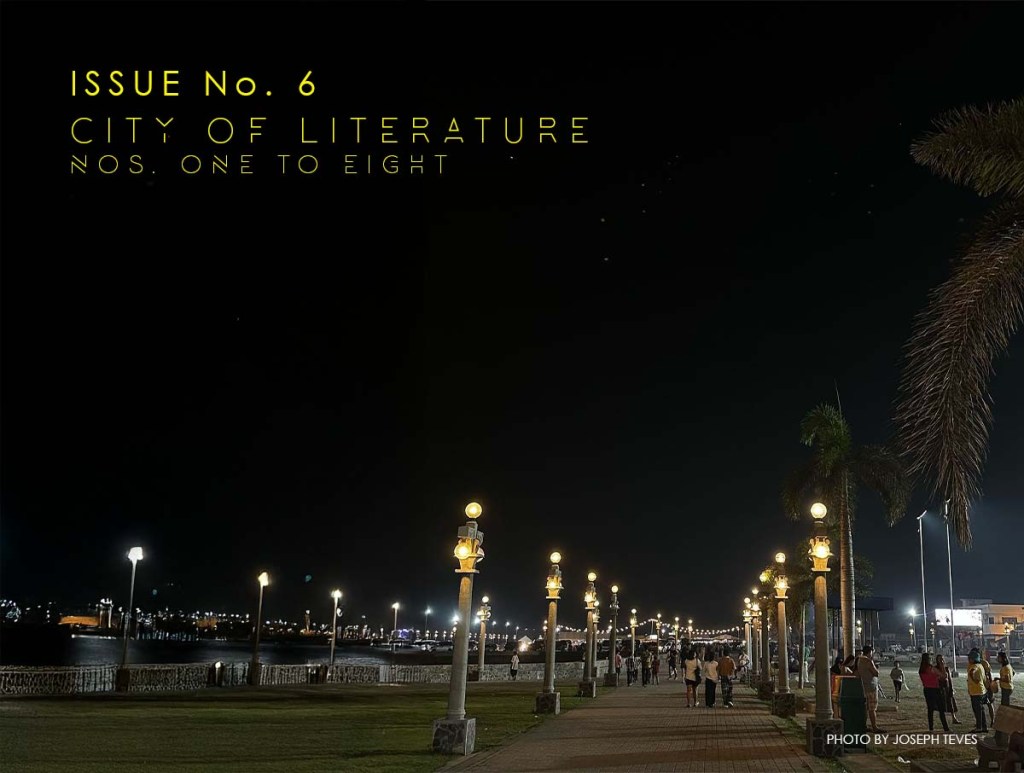
Issue 6: City of Literature, Nos. 1-8

Introduction | Ian Rosales Casocot

On “La Muerte de la Luz” | A Poem by Lyde Sison Villanueva

On Z for Short | A Novel by Cesar Ruiz Aquino

On “Filipina Nude in Quarantine” | A Poem by Grace Monte de Ramos

On Alkanseng Alkansiya | A Play by Earnest Hope Tinambacan

On “Poet in Mid-Career” | A Poem by Artemio Tadena

On “Pamalandong ni Antigo Mokayat” | A Sugilanon by Michael Aaron Gomez

On “A Deer for Jesus” | A Short Story by Lugum Uka

On “Year End” | A Poem by Simon Anton Diego Baena

Introduction to Issue 6: City of Literature, Nos. 1-8

By IAN ROSALES CASOCOT

This is the inaugural issue compiling the City of Literature columns, a regular feature on Dumaguete MetroPost, which celebrates the vibrant literary culture and heritage of Dumaguete City, in anticipation of its bid to be designated as UNESCO City of Literature under the Creative Cities Network. This column is produced by the Buglas Writers Guild, a network of literary artists from Negros Oriental, Negros Occidental, and Siquijor. Each week, we will focus on the work of one local writer. For this month, the guest editor of City of Literature is Dumaguete fictionist Ian Rosales Casocot.

* * *

Each one of us has a crazy dream. To climb Mount Everest, for example, or to write a complicated symphony. Or to bake the world’s largest pizza, if that’s more your thing. In my quiet moments, when I ponder about the things I have written—or plan to write—I think about how wonderful it would be to write a good YA novel, in the vein of The Perks of Being a Wallflower or The Fault in Our Stars, but with a Filipino context and sensibility, something I have yet to really see from a Philippine author.

I have been writing for most of my life, and so it is not exactly out of left field for me to dream of big things that are literary. What is a little bit audacious, however, is an even bigger dream: to make Dumaguete a UNESCO City of Literature. This is part of UNESCO’s Creative Cities Network, which it launched in 2004, to answer what it perceived to be a need to foster appreciation for cultural diversity around the world. The aim is to “promote the social, economic and cultural development of cities in both the developed and the developing world,” through literature, music, film, media, gastronomy, crafts and folk art, and design.

To be approved as a City of Literature, cities must satisfy a number of criteria that mark its affinity to the written word, where literature must be seen to play an important role in city life: this includes the quality, quantity, and diversity of publishing in the city; the quality and quantity of educational programs focusing on domestic or foreign literature in schools at all levels; the hosting literary events and festivals which promote domestic and foreign literature; the existence of libraries, bookstores, and public or private cultural centers which preserve, promote, and disseminate domestic and foreign literature; the involvement by the publishing sector in translating literary works from diverse national languages and foreign literature; and an active involvement of traditional and new media in promoting literature and strengthening the market for literary products. A tall order—but the benefits of being accorded the honor are huge.

To date, there are only 53 Cities of Literature all over the world, which include Edinburgh, Scotland (2004), Melbourne, Australia (2008), Dublin, Ireland (2010), Reykjavík, Iceland (2011), Norwich, England (2012), and Kraków, Poland (2013).

In November 2008, Iowa City in Iowa, U.S.A. became the third city in the world to be declared by the UNESCO as an official City of Literature. Its Creative Cities Network program cites that “[s]ince 1955, graduates and faculty of the University of Iowa have won more than 25 Pulitzer Prizes in literature. Iowa City has been home to such acclaimed authors as Flannery O’Connor, Wallace Stegner, and Kurt Vonnegut Jr. And the world-famous Iowa Writers’ Workshop was the world’s first Master of Fine Arts degree program in creative writing…”

I am specific about my mention of Iowa City as a City of Literature, because halfway around the world, in the heart of the Visayas, Dumaguete is very much Iowa City’s literary twin. Its inclusion in the ranks of these literary cities could prove to be a portal with which we can lay claim to the same distinction.

The writer Rowena Tiempo-Torrevillas, a native of Dumaguete and a current resident of Iowa City once called the latter her “blonde Dumaguete.” Indeed, both share between them a wealth of literary developments that have lasted more than sixty years. “In 1946,” she once wrote, “my father [Edilberto K. Tiempo] was offered a scholarship by the Presbyterian Board of Missions, enabling him to do graduate work in the United States, at Stanford. He was readying himself for the scholarly regimen of the classics, and doing a refresher course in Latin, among his preparations, when my father was asked what area he wanted to specialize in at Stanford. ‘Creative writing,’ he said. ‘There are a number of novels I am going to write, and I need to know if I’m writing them effectively and well.’

“’Oh,’ the Presbyterian Board officer told him, ‘then there’s only one place for you to go. Iowa.’ Dad had to look up Iowa in the encyclopedia, and he was a bit puzzled at what he read. ‘Isn’t that where…they grow corn?’”

Iowa, right smack in the cornfields and silos of the American Midwest, indeed grew corn. But Dr. E.K. Tiempo was soon to learn there was a man there. It was a poet named Paul Engle, and he ran what was and still is considered the best creative writing workshop in the world: the Iowa Writers’ Workshop at the University of Iowa. “And that is how my Dad,” Rowena Torrevillas continued, “took a freighter across the Pacific, then a train halfway across the continent from San Francisco to Iowa City. And one morning, carrying his belongings in an Army-issue duffel bag, he crossed the Pentacrest on the campus to find the postwar temporary quarters in the Nissen huts, the quonset building where Paul Engle was holding the Writers’ Workshop.”

By 1947, Dr. E.K. Tiempo’s wife, Edith Lopez Tiempo, also joined to take part in the writing program in Iowa. When the Tiempos returned to the Philippines in 1951, Silliman University was already abuzz with creative writing. The campus was sprouting literary enthusiasts, among them Aida Rivera-Ford, Rodrigo and Dolores Feria, and Ricaredo Demetillo. The Tiempos made creative writing an area of concentration for English majors in the English Department—and soon that paved the way to preparations in 1961 to hold a workshop similar to the one they attended in Iowa. The following year, it became fully operational, and now it is known as the Silliman University National Writers Workshop.

In 1962, Engle himself visited Dumaguete, and met at the Silliman workshop two Asian writers, Ko Won and Wilfrido Nolledo. These two writers would soon form the nucleus of what was to be the Internatinal Writing Program, which Engle founded in 1967 with his wife, the Chinese writer Hualing Nieh Engle. Rowena Torrevillas, upon returning to Iowa City in the 1980s, would become part of the IWP staff, becoming its coordinator for many years, and editing with Paul Engle the 20th anniversary anthology of the IWP titled “The World Comes to Iowa.” By 2011, nineteen alumni and panelists of the Silliman University National Writers Workshop, would go to Iowa as fellows of the IWP, including Wilfrido Nolledo in 1967, Cirilo Bautista in 1968, Erwin Castillo in 1969, Ninotchka Rosca in 1977, Alfred Yuson in 1978, Rowena Tiempo Torrevillas in 1984, Edgardo Maranan in 1985, Fidelito Cortes in 1986, Marra PL. Lanot in 1986, Susan S. Lara in 1987, Rofel Brion in 1990, Ophelia Alcantara Dimalanta in 1990, Gemino H. Abad in 1991, Marjorie Evasco in 2002, Charlson Ong in 2002, Sarge Lacuesta in 2007, Vicente Garcia Groyon in 2009, yours truly in 2010, and Joel Toledo in 2011.

In 2005, writing fellows from the Nonfiction Writing Program at The University of Iowa, under Robin Hemley, also took part in the National Writers Workshop in Dumaguete, with Angela Balcita, Elizabeth Rae Cowan, Matthew Davis, Bernadette Esposito, Brian Goedde, Jynelle Gracia, Bonnie Rough, and Alex Sheshunoff. The program also sent visiting writers from Iowa to Dumaguete during the workshop’s 50th anniversary in 2011.

It has been a rich literary relationship between two cities. But does Dumaguete have what it takes to be City of Literature? Do we have diversity of publishing in the city? Not exactly, but that can be done, if only we can get visionaries to see the value of a city that publishes books. Do our educational programs focusing on domestic or foreign literature in schools at all levels? They do, but perhaps a sharper focus—with attendant assistance by those in the know—is in order. Do we host literary events and festivals which promote domestic and foreign literature? By God, yes, and plenty of that. Do we have libraries, bookstores, and public or private cultural centers which preserve, promote, and disseminate domestic and foreign literature? Our public library needs help, we can do more than just have National Bookstore in our midst, but we do have cultural centers that do a fine job of literary dissemination. Does the local publishing sector help in translating literary works from diverse national languages and foreign literature? None of that, as yet. Is there an active involvement of traditional and new media in promoting literature and strengthening the market for literary products? It can be done—but we need to do the work.

The Philippine UNESCO Commission has just endorsed Dumaguete as its aspiring City of Literature for 2025. We can do this.  It will be an audacious undertaking necessitating a complete overhaul of how we think of this beloved city. But it can be done.

Lyde Sison Villanueva’s “La Muerte de la Luz”

A national magazine once posed this question to Dumaguete writer and National Artist for Literature Edith Lopez Tiempo: “What makes you stay in the Philippines?” Her answer was short: “The Dumaguete shoreline.” The response is perfectly emblematic of the pull of place in the life of writers, and how important where one comes from is in the life of the imagination.

Dumaguete is a singular place of importance when it comes to literature in the Philippines. For many, it is the hometown of Philippine literature itself, having been the nurturing ground for many of the best writers in the country, and the literal hometown to some of our most important contemporary writers, many of whom have helped shape the country’s literature.

For this inaugural issue of the City of Literature series, we celebrate one such Dumagueteño who is helping shape local literature. A young poet, Lyde Sison Villanueva graduated with a degree in Mass Communication from Silliman University in 2008. He was a fellow for poetry for the 2013 Silliman University National Writers Workshop. He is currently pursuing his MFA in Creative Writing at De La Salle University. His works have appeared in various publications like Sunday Times Magazine and The Quarterly Literary Review Singapore. His first poetry chapbook entitled Made Easy was published in 2019. This year, he won Second Prize for Poetry at the Palanca Awards.

We share the title poem from that award-winning collection:

La Muerte de la Luz

In this Museum of Bones,
the study begins with light.

Fragments of a cranium
are arranged like an unnamed constellation,

attempt to replicate
the shape of the head.

Small patches of discoloration—
a tinge of sepia—approximate the time it lived.

A thousand years before Christ, maybe.
Or even older than fire.

The caliper used to measure its age
is the same period it takes half the carbon

in the specimen to naturally decay.
The other bones are missing

or maybe left unexcavated,
or the body was buried elsewhere.

The label says it is an early human—
unknown gender—but the first to walk

upright and migrate;
a race belonging only to the past.

Its identity is the number of prey
or enemies it defeated only to survive,

the distance of the land bridges crossed,
how did it get here, did it miss home?

With only a few fragments,
conjuring its body—where flesh and organs

used to be—is a near-impossible task

Mr. Villanueva wrote most of the poems in the collection for the creative exercise in his comprehensive exam for his MFA course: “My proposed thesis project is a collection of ekphrastic poetry and I was tasked to write a suite of poems based on the artworks of a Filipino master. I’ve always been interested in the intersection of various forms of art (literary and visual) that’s why I’ve chosen to take on this project.”

Asked how he feels about winning the Palanca, he says: “I’ve always found value in the Palanca awards not just on the national literary scale, but more so on the personal level. I consider the award as a validation of my work as a writer. But most importantly, I treat the Palanca as a production deadline. Every year, since 2018, I’ve tried to come up with a writing project or revise an old one for the Palanca. This is the first time I submitted this collection in the Poetry category and thankfully it won. But I also believe this is the Universe reminding me to finally finish my MFA thesis.”

Cesar Ruiz Aquino’s Z for Short

The poet and fictionist Cesar Ruiz Aquino—an eternal icon of both Dumagueteño and Zamboangueño writing—have been dazzling readers of Philippine literature for decades now, ever since he surged as a wordsmith of “robust eloquence” [from the words of Alfred Yuson, writing about the author for the Philippine Star] in the 1960s and the 1970s. As a member of a highly experimental group of writers that exploded with prominence in those decades—a generation that included Yuson, Ninotchka Rosca, Jose Lansang Jr., Erwin Castillo, Conrado de Quiros, and Wilfredo Pascua Sanchez—it took Sawi, as he is affectionately called by friends, quite a while to gather his writings together, but finally, in the early 1990s, he gave us the one-two punch showcase of the breadth of his writing prowess with his story collection Chronicles of Suspicion in 1990 and his poetry collection Word Without End in 1993. Both books instantly became classics of contemporary Philippine literature—albeit strangely out of print today—simply because there was no one else writing poetry the way Sawi was writing his poetry, and no one else writing fiction the way Sawi was writing his fiction—strange, musical, and—this has to be noted—highly autobiographical.

He became more prolific in his book publishing from the 2000s and after, coming out with an astonishing regularity with such poetry collections as In Samarkand (2008), Caesuras: 155 New Poems (2013), Like a Shadow That Only Fits a Figure of Which It is Not the Shadow (2014), Fire If It Were Ice, Ice If It Were Fire (2016), and Figures In A Long Ago Mirror (2019), as well as the personal anthology Checkmeta: The Cesar Ruiz Aquino Reader (2003). But aside from that brush with Chronicles of Suspicion, he has never published his fiction again in collected form—not that he was not writing fiction. He was still winning awards for the stories he did publish in various magazines—but only until the pandemic did we get new fictional work in a book from him, with Z for Short, the novel he has struggled to finish for what had seemed like forever. The novel is, of course, of the Sawi vein of fiction—still strange, still musical, and still autobiographical.

Here is an excerpt he is sharing:

Our window overlooked the rich orchard. From a branch of the tallest tree hung a dead bird, Fra Hernani and I discovered one day. How or why it died, there was no way for us to know. And the greater puzzle was how it managed to cling on to the tree branch, upside down, as if by sheer will and even beyond that as if it refused to let go of the tree's branch and plunged to the earth and turn to dust, become the earth. True enough it did not seem to deteriorate all the time I was in Manila. It did, of course, but its feathers continued to shield the bird—as if to hide from our sight, from the rest of the world, the fact of its annihilation.

What is the novel about? Here is an excerpt from it that explains itself: “I can’t write a novel is how I’ve come to decide autobiography is what it’s going to be, if failed nonfictionist as well. Autobiographer manqué. At any rate I will be the book. Or rather the book will aspire to be me. But of course, you will say, what book isn’t the author? I mean some reader, perhaps a French girl traveling in the Philippines, who knows English, will read it in bed on a winter’s night, fall asleep still holding the book, and wake up startled by the sensation of a man lying beside her and talking in his sleep, in a word, dreaming. Paris! Friends will recognize the slouch, the somnambular way of walking, the footsteps. The strange inconsistency in speech, by turns articulate and groping (now running over, now clamming up). The stranger inconsistency with the eyes: at times, from a natural inclination, riveted on—at other times, by habit, averted from—the face of the person he’s talking to. The palms. Which are what really rouse the young girl from Paris, though he’s caressing her only in a dream. His dream.”

The book, only recently published, is sold out and also now out of print.

Grace Monte de Ramos’ “Filipina Nude in Quarantine”

If there is one poet from Negros Oriental whose book I am most eager to get my hands on, it will be the Siaton poet Grace R. Monte de Ramos—a resolutely feminist writer who has her pulse on the issues that continue to bedevil the Filipino woman, and renders these concerns in acutely observed verses that not only take these issues with bravery and humor, but also conflates them with the nuances of the female body and the female experiences. In other words, she has always been political, but centers that with a wry female gaze. In 2003, for example, her poem “Brave Woman” was chosen for inclusion in the book Poets Against the War, edited by Sam Hamill for Nations Books—a pathreaking collection of anti-war poems by international writers opposed to the American war in Iraq. Alas, while she has been published widely—in Caracoa, in Ani, in Sands & Coral, in Likhaan, in Philippine Studies, etc.—and is much-anthologized, she has yet to gather her poems together in one volume. Someday, we hope to persuade her with some finality.

Ms. Monte de Ramos, who is married to the poet Juaniyo Arcellana [son of the National Artist for Literature Francisco Arcellana] and now lives in Mandaluyong, earned her degree in Creative Writing at Silliman University, where she studied under the guidance of Edilberto K. Tiempo and Edith L. Tiempo, one of the country’s most distinguished literary couples. She first taught literature at Silliman after graduation, then worked at the Cultural Center of the Philippines before deciding to be a full-time mother and caretaker of cats. But she persists in her literary inclinations by writing, reading, editing other writers’ manuscripts, and translating works into Binisaya [she has translated Alice McLerran’s beloved children’s book The Mountain That Loved a Bird into Ang Bukid nga Nahigugma sa Langgam], while also spending time solving Sudoku puzzles.

In the middle of the pandemic, she wrote this poem for a national publication that eventually chose not to publish it—in fear of the powers that be:

Filipina Nude in Quarantine

I need a Brazilian wax
for this horsehair
growing rampant
around my crotch
but the salons are all closed,
damn this lockdown, and my lover
anyway can’t go to where we used
to meet, bookstore, bar,
even church, where briefly
we rehearsed postures
of body-worship. Why did Harry
have to be gleefully
triumphant about it?
He might not have
kulasisi like Duterte, but I
am secretly one,
a very horny one
whenever my period is done.
I bought two panties
to please my married man,
one red, one black, and now they
have to wait until it’s safe to traverse
EDSA to get to the next tryst.
My groin needs whitening,
my nipples are shriveling from lack
of licking and sucking. Even
phone sex is out, as my husband
is working from home, dispensing
legal advice on Zoom,
and my mewling and moaning
would surely reach him through
these thin walls.
O I miss the windowless rooms
where I could be imperious
like a queen or as slavish
as a bitch in heat.
But I am prisoner
instead. Tell me, generals of checkpoints
and protocols, what do I do
with all this hair?

Of this poem, Grace has this to say: “When Duterte became president many people wrote angry poems about him. I did not, as I was not in the mood for rage-filled or anguish-laced poetry. Indeed, Krip Yuson had to ask me if he could include ‘Brave Woman’ in the anthology, Bloodlust. I hadn’t sent anything. ‘Been there, done that,’ is what I said to him. I wanted to move on from anger to satire, I wanted my poems to laugh in their faces, make them look ridiculous. This poem was obviously written during the Covid lockdown, when we were subjected to many ridiculous rules.”

Earnest Hope Tinambacan’s “Alkanseng Alkansiya”

In 2005, the theatre artist and playwright Dessa Quesada-Palm, a stalwart from Philippine Educational Theatre Association [PETA] came to visit Dumaguete to do a theatre workshop for a bunch of young people interested in theatre—and came to stay. The workshop had ended in a high note, and feeling that something significant was at play with the participants’ heady embrace of the process, she asked them: “Would you like this to continue?” She did not expect the immediate response to be ecstatic. Thus, Youth Advocates for Theatre Arts or YATTA was born.

Among the original participants of that fledgling group that has become a powerhouse of Dumaguete community theatre was a young Mass Communication student from Silliman University named Earnest Hope Tinambacan, son of pastor parents and originally from Oroquieta City, but with roots in Negros Oriental.

Hope would later on become the lead singer for HOPIA, and one of the founding figures of the Belltower Project and the CuadernoSS Singer-Songwriters Collective. In 2019, he would earn a diploma in acting at the Intercultural Theater Institute in Singapore, and right after graduation, founded D’ Salag Theater Collective in Dumaguete. But aside from his preoccupations with music and theatre, he would also write balak—but writing plays is his foremost creative expression. His latest creation is the original Bisaya musical, Pulang Langob. He currently serves as assistant secretary of the Committee on Dramatic Arts of the National Commission for Culture and the Arts.

In 2015, he wrote the short play Alkanseng Alkansiya for YATTA, an advocacy piece tackling poverty, which has just been invited to the Asian Youth Theatre Festival 2024 in Chiang Mai, Thailand under the title Piggy Heist. An excerpt from the original play in Binisaya:

Mogawas si Girlie nga nagmud-ok dala ang iyang cellphone.

Kapitana Honesta: Oh, naunsa naman pud nang nawonga, ’nak? Unsay problema.

Girlie: Ma, akong mga classmates lagi naay iPhone, naay iPad. Pero ako, bati kaayo og cellphone, dili man lang Android. Ma, nganong datu sila, kita pobre?

Kapitana Honesta: Ah, kalisud pud tubagon na imong pangutana. Pero abi nimo, ‘nak, dili man ‘ta pobre. Makakaon man ka katulo sa usa ka adlaw, naa kay balay, naa kay sinina, naa kay cellphone. 

Girlie: Pero nganong ang uban mas dako ang balay, naay sakyanan, ug mga mahal nga butang?

Kapitana Honesta: Tinuod na, anak. Ang atong katilingban karon di gyud makiangayon. Naay pobre, naay datu. Sa atong kahimtang, wala na si Papa ninyo, ako lang ang nagtrabaho og gamay ra ko og sweldo sa akong pagka-kapitan. Igo lang nga makakaon ‘ta, og maka-eskwela mo. (Motan-aw sa nawong sa anak nga nalibog gihapon.) Masabtan ra unya na nimo samtang magkadako ka. Ang ako lang nga ‘di nato usikan ang kwarta, ug dapat ma-antigo mo tigum. (Ngadto kang Millet) Millet, palihug ko og kuha sa atong piggy bank!

Millet: (Kuhaon ang piggy bank, og magdalagan pabalik) Nia ra ma! (Madagma)

Girlie/Kapitana Honesta: Bantay!

Millet: (Mobakod ug mongisi kay wala ra mabuak ang piggy bank) Wala ra mabuak! Sorry!

For Hope, this scene has personal resonance: “This part of the play is actually based on a real conversation between me and my mama when I was a little kid. A conversation that has opened my mind to the realities in the society. I had asked her why we were poor, and she told me: ‘Dili ‘ta pobre, ‘nak. Middle class ‘ta.’ I asked her: ‘Unsa ang middle class?’ She replied: ‘Dili man ‘ta dagkong yutaan ug wala ‘tay dagko nga negosyo ,so di ta matawag og dato. Pero propesyonal man mi ni Papa nimo, og naay ginagmay sweldo. Dayon maka-kaon man ‘ta katulo sa usa ka adlaw. Mao nga dili pud ‘ta pobre. Naa ‘ta sa tunga. Magpasalamat ‘ta sa Ginoo nga dili ‘ta pobre, pero dili pasabot ana nga ato silang ipaka-ubos. Maayo pa atong tabangan.’ I finally asked her: ‘Nganong naay pobre naa pud dato?’ And my mother tried her best to explain inequality, injustice, and a system that makes the poor poorer and the rich richer. She ended it with. ‘Sige ra. Makasabot ra unya ka ana.’”

The next thing he remembered was his parents making him play with the children of their Badjao friends. “They exposed me to families of farmers,” Hope said. “I saw how my father organized sikad drivers and laborers in Ozamiz. I saw how my mother organized small vendors and jobless church women. They made me play with our neighbors, one of them a family of at least eight children. The fisherman father arrives late in the afternoon with his catch. The big ones they sell, while they feast on the small ones which they even willingly shared to me. My parents made me and my brother experience selling fish around the neighborhood.”

He continued: “If there’s one thing I clearly remember seeing all these as a kid is this: I never saw laziness among these people, only lack of opportunities, inequality, and injustice. My father was a farmer and my mother was a lab-asera [or fish vendor] before they went to the seminary as working students at Silliman University. They were products of what some politicians call ‘Sipag at Tiyaga,’ a slogan that makes us all think hard work and perseverance are the only way to escape poverty. But my parents made it clear to me that ‘sipag at tiyaga’ aren’t enough to alleviate the situation of the poor people, who comprise the majority of the population of this country. It is an entire anti-poor and pro-rich system that needs to be changed, and only a united force of people with a common understanding and goal to change it can make it happen.”

Artemio Tadena’s “Poet in Mid-Career”

Poets writing about the craft [or the life pursuing the craft] is nothing new, but there is something compelling—and also, sadly, foreboding—about this 1968 poem about being a “mid-career poet,” written by the Dumaguete writer Artemio Tadena. When he published this, he was still really at the beginning of prolific career as a published poet, also at the cusp of winning various national awards, and nine years before he would die:

Poet in Mid-Career 

And wherever I go, there would also go
Spirals of roses, enameling of songs,
Birds on golden boughs—there, with them, is where I belong.
Angels and bell buoy weather, denominations and
Powers: these, too, to my triumph will be witnesses,
Not merely tides and cliffs — or pinioned land.

Circling now the spirals of the sun, he saw
That flight did not bring him any farther from his home:
Nor any graduate level from that which hovered into view:
Momentarily he hung — then
plum —
metted
into
the
foam: —
Content at last with what he scaled to bring
After repeated circling and circling:
His own self it was he wanted to,
But, alas, could never escape from.

Tadena was only 37 [on the eve of turning 38] when he died on 5 December 1977, just a day before his birthday on December 6. We could let this past week of December pass then without at least commemorating his memory.

A popular literature teacher at Foundation University, Boy [as he was called by friends and family] was serious about his poetry—he was a fellow at the Silliman University National Writers Workshop in 1969 and had trained, if briefly, under the Tiempos, and later he won three Palanca Awards for his efforts: second prize in 1969 for his collection Northward Into Noon, another second prize in 1972 for The Edge of the Wind, and finally first prize for Identities in 1974.

Three years after his last Palanca win, he would be dead. He was such a young man when he succumbed to a fateful cardiac arrest—and one might say, robbed of further attaining poetic heights that were well within his grasp. Today, almost no one remembers this singular poet from Dumaguete.

In 2016, two other poets—Myrna Peña-Reyes of Dumaguete and [soon to be National Artist for Literature] Gemino H. Abad of Manila and Cebu—would try to resurrect his name and poetry, and came up with an anthology of his poetry, This Craft, As With a Woman Loved: Selected Poems, published by the University of Sto. Tomas Publishing House.

From the biographical afterword of that book, Peña-Reyes writes: “We realized [in 2010, during a break in the Silliman Writers Workshop] that hardly anybody now knows the young Dumaguete poet of our generation whose outstanding work earned prestigious literary awards before his untimely death… Except for a few poems in some anthologies, his work is not available, all of his books having been out of print for decades.”

Together, Peña-Reyes and Abad set to gather Tadena’s poems from several collections, as well as take inventory of the ones in miscellaneous publications—mostly school papers and journals—housed at both the Foundation University Library and the Silliman University Library. Abad would edit and annotate the poems, and Peña-Reyes would endeavor to write a definitive biographical essay of the man.

Because of the book, we now know that Tadena’s mother, Eufrecina Maputi, was a Dumaguete native, and his father, Eugenio Tadena Sr., was an Ilocano who had settled in Dumaguete after finding work as a foreman in a road construction company in Negros Oriental. Eugenio’s first two wives died in childbirth; Eufrecina would become his third wife, and she would bear him three children, Artemio being the eldest. All in all, Eugenio would sire sixteen children with four wives.

We know that Tadena would matriculate at West Central School [now West City Elementary School], where he displayed an uncanny intellect even as a child, and a hankering for the arts. In 1951, for example, a watercolor painting of his earned worldwide recognition in an arts competition sponsored by UNICEF. He would later attend the high school at East Visayas School of Arts and Trade [or EVSAT, now the Negros Oriental State University]. He edited the school paper, and won prizes at various declamation and oratorical contests.

We know that he was a parttime college student at Silliman University, where he wasted no opportunity to publish his poems and essays in the two student publications—The Sillimanian and Sands & Coral, the prestigious literary folio of the university. The staff of The Sillimanian found him “strange,” “weird,” “aloof,” and “proud”—and he would sulk and go on a tantrum when his poems would not get published.

We now know that his first publication, in 1957, was with the Sands & Coral, with the poem “What is This Life We Lead and Lead?” And even then, his singular poetic style made him stand out. “I didn’t understand completely what [the poem] meant,” Peña-Reyes writes, “but instinctively, I recognized the voice of a genuine poet and became a fan.” She also recalls having serious conversations with him—“It was always serious, no bantering or frivolous talk, and I thought he took himself too seriously. He was brimming with ideas and information about poets and their work… No wonder he made people uncomfortable—he just had too much he wanted to share, and with such passion and earnestness.”

We know that he truly flourished at Foundation College [now Foundation University], where he eventually transferred. He was on the honor roll and edited the school paper, and when he graduated with an A.B. degree, he was recipient of the Presidential Pin award. Later, Foundation would hire him to teach English and literature. There, he would become a professor, chair of the dramatics guild, and adviser and editor of several campus publications. At the time of his death, he was head of Foundation’s English Department, as well as its Office of Publications and University Research.

We know that he married the Cebu writer and dancer Gemma Racoma in 1967, and had two boys, Ireland Luke and Adrian Gregory. The marriage did not last. Gemma would leave for a life abroad with their children, and Artemio returned to Dumaguete to live with his family.

We know that he published independently five books of poetry: aside from the aforementioned Palanca-winning collections, he would also come out with Poems (Volume One) in 1968 and The Bloodied Envelope in 1973. That last title won him first place in the Cultural Center of the Philippines Award for Poetry, also in 1973.

We finally know that he had just passed the Bar exam when he died—alone in his room, in the process of tying his shoes, ready to go to work.

Remembering his poetry, we know that he went where there will be “spirals of roses, enameling of songs / Birds on golden boughs—there, with them, is where I belong.”

Michael Aaron Gomez’s “Pamalandong ni Antigo Mokayat”

Here’s an excerpt from the Palanca-winning short story “Pamalandong ni Antigo Mokayat” by the Dauin writer Michael Aaron Gomez:

Kon akoy pangutan-on di man nimo kinahanglan mobasa og daghan. Tan-awa: ang akong basahon dires balay ang karaang Bibliya sa akong lola, mga basahon sa pangadye, mga karaang dyaryo. Di bitaw ko mobasa pero maminaw ko. Maminaw kog radyo mabuntag, balita mahapon, balita magabii. Mga istoryas mga amigo bahalag puro binuang. Bahalag puro inamaw, puro binastos. Mga hunghong sa katigulangan. Day kabalo ba ka nga si…si kuan biya kay…Gaw tan-awa ra god nas kuan, morag… Kabalo ko ana, mas insakto pa nang akong mga madunggan kaysa akong mabasahan. Pero lagi kuno art man kuno nang iyang gibuhat, kinahanglan niya magtigom og libro.

Ingon pas Michael, di diay ka ganahan mahinumdoman sa mga reader, bay? Pinasagad man na gaw, maoy akong tubag. Pero kabalo ko oy. Naa ra koy trabaho kay daghan mobasa sa akong mga gipanulat matag adlaw. Kon masipyat gani ko o naa silay di ganahan ingnon man ko nila didtos among FB o di ba kay tawagan nila among opisina kay magbagotbot didto: ngano kunong si kani gipusil o di ba kato siya kay gitulon og bitin, mga ana ba. Ako wala ra pod ko kay kabalo man pod ko nga si bossing ang gabayad sa akong sweldo. Sa ato pa: kon naay reader gaatubang nako karon dire, moando ra ko niya. Morag: gaw, nakit-an tika, nagbagotbot ka, pero wala koy labot, pero salamat pod kay nibasa ka. Kon gusto ka may pa manginom ta aron mawala nang imong problema. Atbanganay ta, morag si Boy Abunda. Tan-awa ning akong “magic mirror.” Unsay imong isulti sa imong kaugalingon?

Wa ko kaila nila—wa sad sila kaila nako. Unta mao kini atong timan-an sukad karon. Ikaw isip reader wa ko kaila nimo; ako isip manunulat, wa ka kaila nako. Ako rang mama ug ang Ginoong Makagagahum sa Tanan ang nakaila nako. Unta makontento na ta ana.

* * *

Is Michael Aaron Gomez, writing in Binisaya, an anomaly among local writers? Here’s the thing: when you are a writer from Dumaguete City—or once trained under the pioneering creative writing program ran by Edilberto and Edith Tiempo at Silliman University—this usual kind of pigeonholing occurs: that you write exclusively in English, and is hopeless in the area of literary writing in the local language, which is Binisaya.

This is absolutely untrue. The closest thing to this might be our popular reluctance to write in Filipino [which is really Tagalog], and this is encapsulated in a retort Edilberto Tiempo once gave. Asked once why he wrote almost exclusively in English and not in the “national language,” he gave this telling answer: “I do not want to be colonized a second time.” Truth to tell, Tiempo, a Waray who has written important works of fiction in English, actually also wrote in Binisaya: many of his wartime reportage published on The Daily Sillimanian, a clandestine publication published before and during the Japanese occupation of Negros Oriental, were written in the local tongue.

But we must grant this pigeonholing some kernel of truth. Oral and folk literature abound, but literary writing as we know it now did not really have a strong foundation in the province even during the Spanish colonial period. Only with the coming of the Americans—and especially the foundation of Silliman Institute in 1901—did a semblance of modern creative writing take place. And because the teachers were American missionaries, this constituted mainly attempts by their students at a literary writing in English. The early issues of Silliman Truth—the first true community paper of Dumaguete—actually had sections devoted to both Spanish writings and Binisaya writings, but these missives were of the journalistic variety. Silliman students, who were taught to read such works by Daniel Defoe, Nathaniel Hawthorne, Washington Irving, Lord Alfred Tennyson, Henry Wadsworth Longfellow, and James Russell Lowell, followed the form and expression of the authors they read, and wrote mostly romantic literature in the English language in the first quarter of the 20th century. As late as 1925, we still got pronouncements in The Sillimanian, the official school organ, that tried to reckon with the English-only orientation in campus: “We should always bear in mind that if we are learning our own dialects, Silliman cannot help us out and we had better not be here. It is evident that we are here to learn among other things, to read, to write, and to speak in English correctly.”

When the Tiempos founded the Silliman University National Writers Workshop in 1962, the accepted manuscripts were in English—and this continued on for many years, creating the reputation that the workshop was the bastion of English writing in the country. (In 2018, however, the first manuscripts in Binisaya were finally accepted.)

This does not mean, however, that the fellows of the workshop—and especially those who also studied at Silliman University—have written only in English. It is actually quite telling that many of the alumni of the creative writing program at Silliman later went on to establish writing careers that included delving seriously into the so-called “regional literature.” This would include Marjorie Evasco, Leoncio Deriada, Erlinda Alburo, Merlie Alunan, and Christine Godinez-Ortega, who have devoted much of their academic scholarship exploring regional writings. [Evasco is known for her translations of works in Binisaya; Deriada is considered by many as the Father of Western Visayan Literature, championing works in Hiligaynon and Kiniray-a; Alburo was once the Director of the Cebuano Studies Center at the University of San Carlos in Cebu City; Alunan authored the groundbreaking anthology, Sa Atong Dila: Introduction to Visayan Literature in 2013; and Ortega is one of the co-founders of the Iligan National Writers Workshop, most known for its pioneering inclusions of manuscripts in the regional languages.] They have also written significant bodies of work in Binisaya, in Waray, and in Hiligaynon. Other local writers in Binisaya also include Hope Tinambacan, Junsly Kitay, Benjie Kitay, Nicky Dumapit, Grace Monte de Ramos, and Lina Sagaral Reyes. Enriquita Alcaide is known nationwide for being one of the best contemporary practitioners of the balitaw. And to date, we have several Silliman writers who have won the Palanca for the short story in Cebuano, including Shelfa Alojamiento, who won for “Ang Mga Babaye sa Among Baryo” in 2002, and Alunan, who won for “Pamato” in 2007.

Add to that Palanca-winning list the Dauin writer Michael Aaron Gomez. He graduated with a degree in creative writing from Silliman University in 2017, and was a fellow at the Silliman Workshop in 2012 and the IYAS Creative Writing Workshop in 2013. His first Palanca win was in 2016, when he won for the one-act play “Tirador ng Tinago.” In 2024, he won both a special prize for the novel in English for The Republic of Negros, and the first prize in the short story in Cebuano for “Pamalandong ni Antigo Mokayat.”

Of his short story, Mr. Gomez remarked: “I had wanted to try writing in Cebuano for a while but I didn’t have enough confidence I could pull it off for a sustained form like the story. But once I had the character’s name, the voice came after, and then the process became easier.”

Why this short story? “The story is one of the results of my self-examinations about what it means to be a writer not only in the Philippines, but also—and more importantly—in the regions. I wanted to create a  direct response or a counter-image to what we commonly interpret as ‘literary writers,’ at least from my various experiences, and see whether there was any fruitful tension between the two, and then explore the idea of the validity of this counter-image as a literary practitioner as well,” Gomez said.